Inclinometer Cable 4x0.5 mm2, Bare Copper, PE, TPU Sheath, 7.7 mm
Specialty & Instrumentation Cables · Industrial Automation
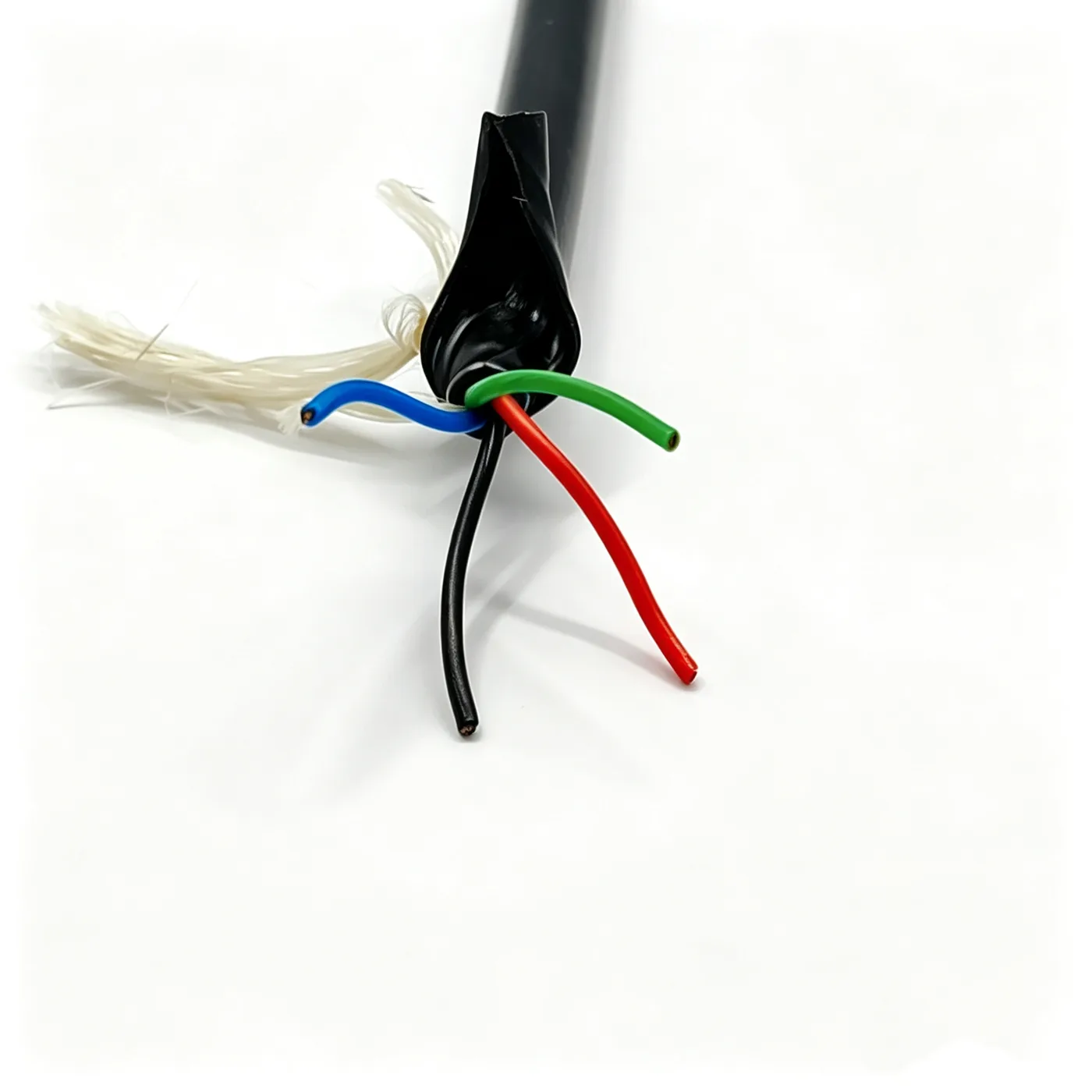
Inclinometer cable 4x0.5mm2
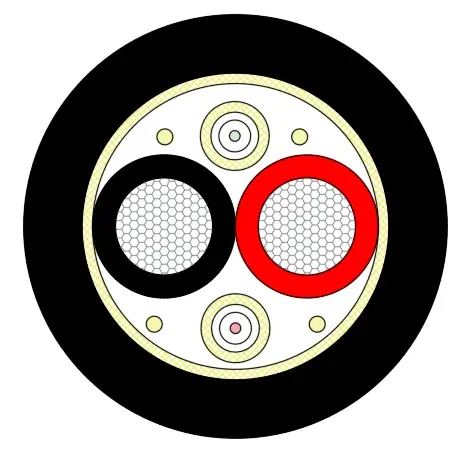
Inclinometer cable, 4x0.5 mm2 bare copper, 0.25 mm PE insulation, LCP central strength core and 8-yarn braid, matt black TPU sheath, 7.7 mm OD.
Product overview
The inclinometer cable is used for signal transmission in inclinometers, borehole inclination surveys and engineering geological exploration. These environments are usually wet and muddy, and the cable is repeatedly lowered and retrieved with the instrument, placing high demands on flexibility, abrasion resistance and sheath hydrolysis resistance. This product uses a multicore symmetrical construction with fine, flexible conductors and insulation, and a matt thermoplastic polyurethane outer sheath, so it can be moved repeatedly at a small bend radius while keeping the signal path stable.
The overall design approach is: stranded conductors for flexibility and bend fatigue resistance, colour-coded insulation for matching at both ends, a central strength member together with a braided reinforcing layer to carry pulling loads, and an outer sheath to resist abrasion, hydrolysis and media attack. The product suits measurement work requiring continuous signal transmission and frequent deployment.
Construction and materials
Conductor: bare copper strands,
Insulation: PE, thickness 0.25 mm, core diameter 1.4 mm, colour-coded red, green, blue, black
Cabling: insulated cores cabled with left-hand lay in colour order, symmetrical construction with balanced loading
Central strength core: LCP tensile fibre, 1000D
Inner sheath: matt TPU, extruded diameter 4.3 ± 0.1 mm
Reinforcing braid: 8 LCP tensile fibre yarns, braided in 4+4 groups, coverage 50%, braided diameter 4.7 mm
Outer sheath: TPU, thickness 1.5 mm, matt black, finished diameter 7.7 ± 0.2 mm
The conductor is stranded from fine bare copper wires with the stranding direction opposite to the cabling direction, reducing untwisting and strand separation during deployment. Polyethylene insulation has stable dielectric performance and low water absorption, and the colour coding aids identification and termination on site. Cabling follows the colour order, giving a round core and uniform lay as a stable geometric basis for the subsequent extrusion and braiding.
A tensile fibre at the centre of the core acts as the central strength member and, together with the inner sheath, forms the first load-bearing and shape-retaining structure; the inner sheath is extruded tightly over the core, fixing core positions and preventing braid yarns from embedding in the insulation. The reinforcing braid is formed by bundles of tensile fibre braided in counter-rotating groups, which both carries tensile load and cushions between sheath and core, reducing relative displacement during bending. The outermost layer is extruded matt thermoplastic polyurethane: non-reflective, dry to the touch, and with good abrasion, oil and hydrolysis resistance.
Key features
- Flexible construction: fine-strand conductors with multi-fibre reinforcement distribute internal stress evenly during bending.
- Dual load path: the central strength core and the braided reinforcing layer each carry tensile load, giving a clear load path under pulling.
- Weather-resistant sheath: the matt polyurethane outer sheath is abrasion and hydrolysis resistant and copes with wet and muddy conditions.
- Clear colour coding: insulation is arranged in a fixed colour order, reducing errors in field wiring and fault tracing.
- Compact construction: multi-layer coverage gives stable diameter control for coiling and passage through instrument winches.
Electrical and mechanical performance
Electrically, the cable uses bare copper conductors with stable DC resistance and low signal attenuation; low water absorption insulation helps signal integrity over long distances. Specific values for rated voltage, insulation resistance and withstand voltage can be customised per project and are subject to the specification document confirmed by both parties.
Mechanically, tensile load is shared mainly by the central tensile fibre and the braided reinforcing layer, so the conductors do not carry the main pulling force and individual wires are unlikely to break under repeated deployment within a reasonable tension range. The abrasion and tear resistance of the outer sheath protects the core and resists short-term crushing and towing friction. The outer diameter is held within a controlled tolerance after multiple processes, easing passage through winches, sheaves and seals. Minimum bend radius, permissible tensile load and operating temperature range are likewise defined per project.
Typical applications
- Signal transmission for inclinometers and borehole inclination survey equipment
- Mobile measurement in engineering geological survey and geotechnical monitoring
- Instrument signal connections in borehole or underwater environments
- Measurement and inspection work requiring frequent lowering and retrieval
In these applications the cable usually passes through casing, sheaves or winches together with the instrument, so flexibility, diameter consistency and sheath abrasion resistance directly affect service life. The matt polyurethane outer sheath does not readily hold mud, making cleaning after retrieval easier; colour-coded insulation also allows quick verification of core order on site.
Selection and customisation notes
- Core count and conductor cross-section: adjustable per project; this version suits general signal transmission.
- Conductor material: besides bare copper, tinned copper can be selected for moisture protection and easier termination.
- Insulation material: polyethylene, polypropylene and similar materials can be selected according to signal type and environment.
- Strength members: the number of central strength cores and braided reinforcing yarns can be configured for the required load capacity, and other fibre materials such as aramid can be used.
- Sheath: matt or transparent polyurethane sheath, sheath colour and print marking can all be defined per project.
- Length and ends: supplied on multiple reels as required by the installation, with end caps or reserved lengths customised as needed.
For performance values not listed on this page, refer to the specification document confirmed by both parties. The product brand is PAIDE (PAIDE Cable), and models can be assigned in the PDK series.
Related in Specialty & Instrumentation Cables
 Custom
 Inclinometer cable 4×0.34 mm²
 On request
 PDK41904
Engineering enquiry