7×0.5mm² Lightweight Tethered Drone Cable 5.5 mm
Tethered Drone Cables · Tethered Systems
7×0.5
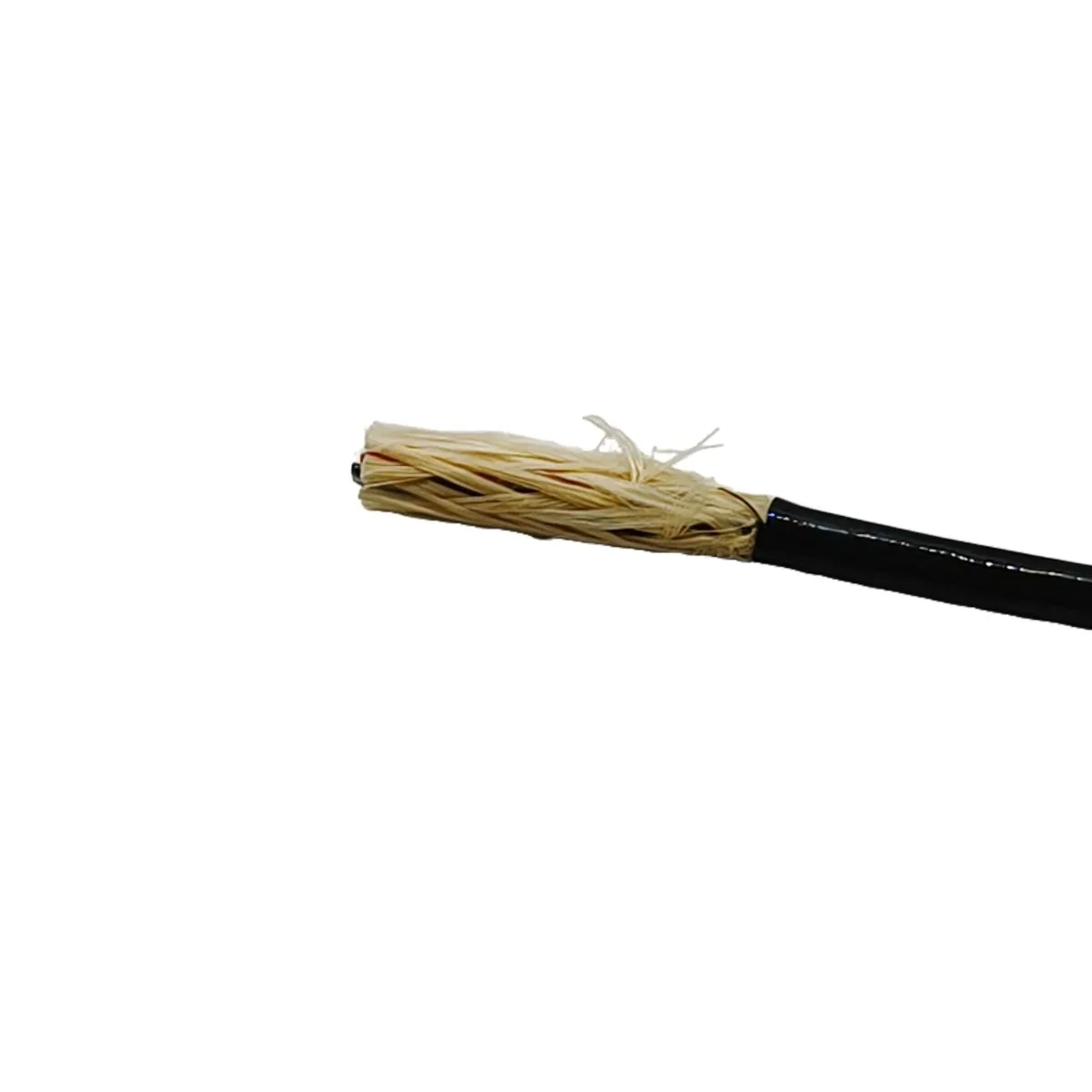
Seven-core 0.5 mm² lightweight tether with tinned copper, FEP insulation and sheath, LCP fiber braid, 5.5±0.2 mm diameter and 65.4 g/m weight.
Product overview
This product is a lightweight multi-core cable for tethered drones and lighter-than-air platforms, carrying both power transmission and signal return. The whole design follows a lightweight approach: tinned copper conductors to control DC resistance, low-loss fluoroplastic insulation, a high-strength fiber braid over the core as the strength member, and a fluoroplastic sheath to finish. This layered construction gives the cable sufficient tensile capacity while keeping weight per unit length low, which suits the long hovering and repeated launch and recovery of tethered systems.
Compared with ordinary flexible cables, the demands on a tether are more concentrated. First, it must be light: every gram on the airborne side takes away payload. Second, it must resist tension and repeated folding: the cable hangs in the air for long periods and is reeled as the platform rises and falls, so the strength member must be clearly separated from the conductive elements. Third, it must be electrically stable, since power and signal are often carried in the same cable. This product organizes materials and construction around these three points, treating weight, load bearing and electrical performance within one design.
Construction and materials
- Conductor: tinned copper,
- Insulation: FEP, 0.22 mm thick
- Outer sheath: FEP, 0.45 mm thick, black
The conductor is bunched from tinned copper strands with a single-core cross-section of 0.5 mm². The tin coating forms a dense layer on the copper surface that slows oxidation and corrosion in damp conditions and makes soldering and terminal crimping more reliable; the finely stranded construction resists single-strand fatigue under repeated bending, which is standard practice for lightweight mobile cables.
The insulation is extruded FEP fluoroplastic, giving a core diameter of 1.35 mm. The material has a low dielectric constant, low dielectric loss and good chemical resistance, and holds stable electrical performance over a wide temperature range, which is why it is often used for small-diameter signal cores; the cores are colored black, red and yellow for quick identification of circuits and polarity on site.
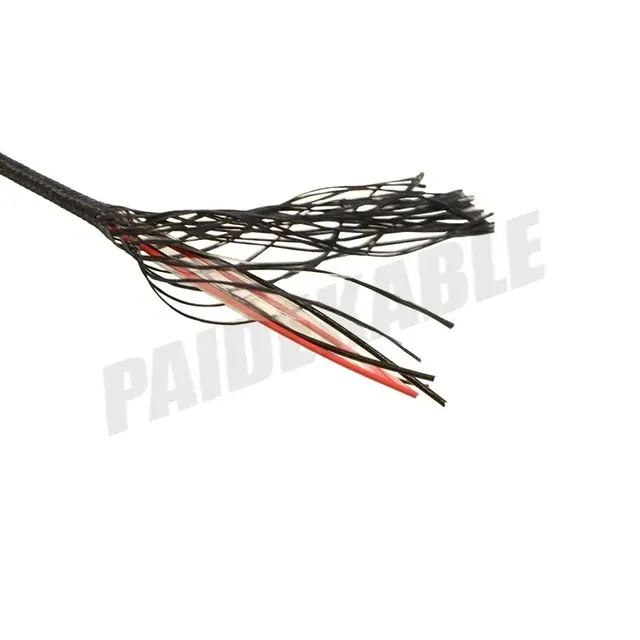
Cabling is carried out with 7 cores in a left-hand lay, giving a cabled diameter of 4.1 mm. A relatively loose lay reduces the bending stiffness of the cable and balances the load between cores when the cable is tensioned; polyester tape is wrapped over the cabled core to hold it together and separate it from the braid, preventing the braid wires from pressing directly on the insulation surface.
The braid uses LCP fiber of 1500D specification, cross-braided in an 8+8 arrangement with 16 spindles at 50% coverage. LCP fiber has high modulus, high tensile strength and good resistance to repeated bending, so the braid both carries the axial load and provides abrasion protection, reducing wear on the inner cores during handling and keeping the cable from loosening structurally under wind loads.
The outermost layer is an FEP sheath applied by pressure extrusion, with a finished outer diameter of 5.5±0.2 mm. The sheath and the insulation are both fluoroplastics, so their properties match and the interface is stable, which keeps appearance and performance in outdoor sun, rain and alternating temperature. The sheath thickness is chosen so that it covers the braid texture without adding unnecessary weight.
Key features
- Lightweight design: tinned copper conductors with a high-strength fiber strength member keep weight per unit length low, which suits payload-sensitive tethered platforms.
- Clear division of load: the braid carries the axial tensile load independently, so the conductors and insulation are not loaded directly and the construction stays stable in long hovering duty.
- Bend resistant: bunched conductors and a loose cabling lay reduce bending stiffness, which suits frequent reeling, coiling and towing.
- Electrically stable: fluoroplastic insulation has stable dielectric performance, and the small-diameter cores handle both power supply and signal return.
- Environmental tolerance: insulation and sheath come from the same material family, giving good resistance to moisture, temperature difference and UV.
- Compact construction: multiple cores are integrated in one cable, reducing the number of harnesses in the tether and helping to lower airborne drag.
Electrical and mechanical performance
The measured weight is approximately 65.4 g/m. For a tethered system the weight figure is directly linked to usable payload, so the design usually needs to check the airborne load against cable length and leave margin in the handling mechanism.
Rated voltage, insulation resistance, withstand level, operating temperature range and minimum bending radius must be confirmed for the specific conditions and can be agreed in the specification document confirmed by both parties. The long-term tensile capacity of the cable is set by the braided strength layer; the agreed tension and bending conditions should not be exceeded in use, to extend service life.
Typical applications
The product suits the power and signal return link of tethered drones during long hovering operations, including the connection between the airborne payload and the ground power station, and data transmission between airborne equipment and the ground control station.
For tethered balloons, lighter-than-air platforms and similar applications that require continuous airborne presence, the cable can likewise serve as a combined power and signal channel; for mobile platforms that need frequent reeling and coiling, the flexibility provided by the bunched conductors and loose cabling lay makes the cable easier to handle with a drum or cable manager.
The same construction approach also applies to small and medium mobile equipment that is weight sensitive but needs multiple electrical connections, and can serve as a reference for similar lightweight multi-core cables.
Selection and customization
- Core count, cross-section and core color identification can be adjusted to project requirements.
- Sheath material and color, finished length, and reel or coil packing can be customized on request.
- Braid coverage and fiber specification can be agreed according to the actual tensile and abrasion requirements.
- Downstream operations such as plugs, terminal crimping and assembly work can also be undertaken.
- Special conditions such as high temperature, oil contamination and frequent bending should be stated at the selection stage so that materials and construction can be matched.
- Electrical and mechanical values not listed on this page are subject to the specification document confirmed by both parties.
Related in Tethered Drone Cables
 2×20AWG
 Drone cable 2x22AWG+2x1 fiber
 Drone cable 4×1.2
 PDK41301-4×22AWG
Engineering enquiry