Watertight Cable 4×1.0 mm², TPEE Insulation, TPU Sheath, 9 mm
Watertight Optoelectric Cables · Marine & Subsea
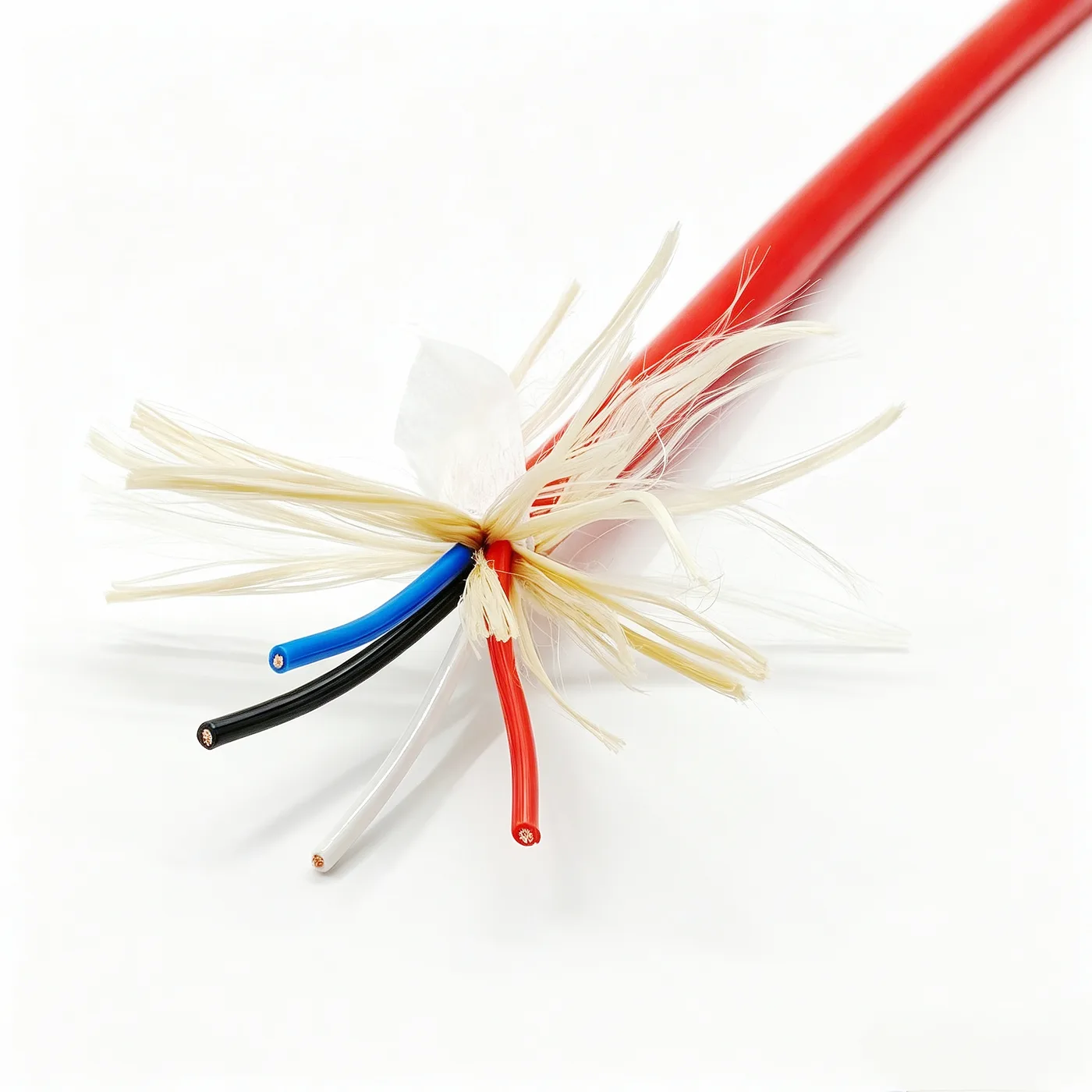
Watertight cable 4 × 1.0 mm²
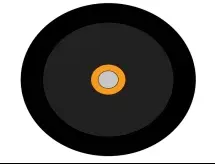
Four-core watertight power cable, 4 × 1.0 mm² bare copper, TPEE insulation, LCP fibre fillers and braid, red TPU sheath, 9 ± 0.3 mm.
Product overview
Watertight cables carry power and signals for underwater equipment and in damp environments, and their core requirement is to keep insulation performance stable, the construction compact and the mechanical strength reliable under long-term immersion. This product is a four-core medium-section construction: bare copper stranded conductors, thermoplastic polyester elastomer (TPEE) insulation, high-strength liquid crystal polymer (LCP) fibre filling in the core interstices, a fibre braid reinforcement layer and a red TPU sheath. The cable balances flexibility, tensile capacity and water-pressure resistance, and suits fixed installation as well as duties involving slight movement.
Compared with ordinary rubber-sheathed cables, the watertight construction differs mainly in filling and reinforcement: the spaces between cores are filled with fibre and tape, greatly lengthening the path for water to travel along the cable, while the braid carries the main tensile load so that sheath and insulation are not directly loaded in tension, reducing the risk of deformation and cracking after long-term loading.
Construction and materials
- Conductor: bare copper strands, 1.0 mm² per core, 1.3 mm diameter after stranding
- Insulation: TPEE, 0.65 mm thick, 2.6 mm insulation diameter, four cores coloured black, white, red and blue
- Cabling: four cores stranded in a left-hand direction to a core diameter of 6.3 ± 0.3 mm, interstices filled with 10 × 3000D LCP fibres and wrapped with non-woven tape
- Reinforcement: LCP 1500D fibre, 8+8 braid, 16 spindles in total, coverage about 50%
- Outer sheath: TPU, 1.2 mm thick, red, finished diameter 9 ± 0.3 mm
The conductor is made as a multi-strand construction with fine individual wires, so that the layers share load more evenly in bending and the work-hardening and breakage seen in a single heavy conductor under repeated flexing are avoided. TPEE insulation combines elastomer flexibility with engineering-plastic strength, changes little in volume resistivity when wet, and resists oil and hydrolysis, which suits long-term immersion. The four cores are colour-coded so that phase sequence can be identified on site without relying on print marking.
The interstices between cores are filled with LCP fibre. This fibre has high tensile strength and low water absorption, so it both blocks water and contributes tensile capacity along the cable axis. The non-woven tape over the core binds the four cores into one round assembly and reduces misalignment during braiding and sheathing.
The reinforcement is an 8+8 counter-laid LCP fibre braid, with braid angle and spindle count set to suit the tensile and flexibility requirements of the cable. The braid sits inside the sheath and forms a composite structure with it, so that pulling loads are carried by the braid. The outer TPU sheath is applied by extrusion with uniform thickness and a smooth surface; it resists abrasion, hydrolysis and low temperature, and the red jacket is easy to identify and inspect underwater.
Key features
- Longitudinal water blocking: filled interstices plus tape wrap lengthen the axial path for water, suiting long-term immersion
- Load bearing separated from conduction: tensile load is carried mainly by the LCP braid and filler fibres, not by the conductors
- Stable electrical performance: TPEE insulation keeps high insulation resistance when wet, with no crosstalk between the four cores
- Good flexibility: stranded conductors with relatively thin insulation and sheath allow bending at a small radius
- Reliable sheath: TPU resists abrasion, hydrolysis and oil, and withstands long immersion in seawater and fresh water
- Compact construction: four cores plus fillers and braid form a round cable with a stable diameter, easy to route through conduits
Electrical and mechanical performance
The product is designed for underwater power transmission; the four cores can serve as phases and return, or some cores can be used for control or signal circuits as the project requires. Rated voltage, long-term operating temperature, minimum bending radius, tensile strength and DC resistance are all subject to the specification document confirmed by both parties. Different depths and installation methods call for different sheath thickness and braid density, which can be adjusted to project conditions.
- Rated voltage: subject to the specification document confirmed by both parties
- Long-term operating temperature: subject to the specification document confirmed by both parties
- Minimum bending radius: subject to the specification document confirmed by both parties
- Tensile strength: subject to the specification document confirmed by both parties
- Conductor DC resistance: subject to the specification document confirmed by both parties
The structural redundancy means the cable is unlikely to develop sheath bulging or core breakage under repeated handling or water flow impact, and the close fit between braid and sheath reduces interlayer slip caused by underwater vibration.
Typical applications
- Power circuits for ROVs and underwater working equipment
- Supply and signal leads for underwater cameras, lighting and sensor equipment
- Fixed wiring in pools, on hull bottoms, at gates and in other permanently immersed locations
- Underwater connections for ocean observation platforms and hydrometric monitoring equipment
- Underwater towing and suspension cables that must take some tensile load
- Power wiring in industrial sites where damp and oil contamination occur together
In these applications the cable usually has to be both water-resistant and tensile-resistant. Thickening the sheath alone improves water and abrasion resistance but adds weight and stiffness; increasing conductor size alone raises current capacity but reduces flexibility. By using fibre fillers and a braid for load bearing, this product achieves a long service life with modest sheath and insulation thickness, which is a balanced approach for underwater power wiring.
Selection and customisation notes
- Establish the core count and cross-section first. Four cores suit three phases plus return, or two independent supply circuits; if signals must also be carried, data pairs or fibre units can be added to the construction.
- Establish the depth and immersion duration. Long-term immersion and brief water contact place different demands on the water-blocking structure, so the filling method and number of tape layers can be adjusted to the duty.
- Establish the loading mode. Fixed installation can use the standard construction; for suspension or towing, state the tensile requirement so that the braid and strength fibres carry the load.
- Establish the ambient medium. Seawater, fresh water, oil contamination and low temperature all influence sheath material selection, so the sheath compound can be changed or an outer jacket added per project.
- Establish the installation space. Where the bending radius is restricted, stranded conductors with a thinner sheath are the preferred construction.
Colour, sheath material, core count and cross-section combinations, shielding and braid density, and joint and termination methods can all be customised per project; specific parameters are subject to the specification document confirmed by both parties. During installation, avoid tying knots in the sheath or clamping it with metal fittings, and apply pulling force to the braid or a dedicated strength member to limit local stress concentration in the sheath.
Related in Watertight Optoelectric Cables
 4×2×24AWG (UTP) + 2×14AWG + 2×12AWG
 Custom
 Longitudinally watertight cable 2×22AWG+STPCAT6-100KG
 PDK81301
Engineering enquiry