Zero-Buoyancy Cable 2×0.75mm² + 1×2×0.2mm², Single Sheath, Foamed TPU, 8.4mm
Zero-Buoyancy Cables · Marine & Subsea
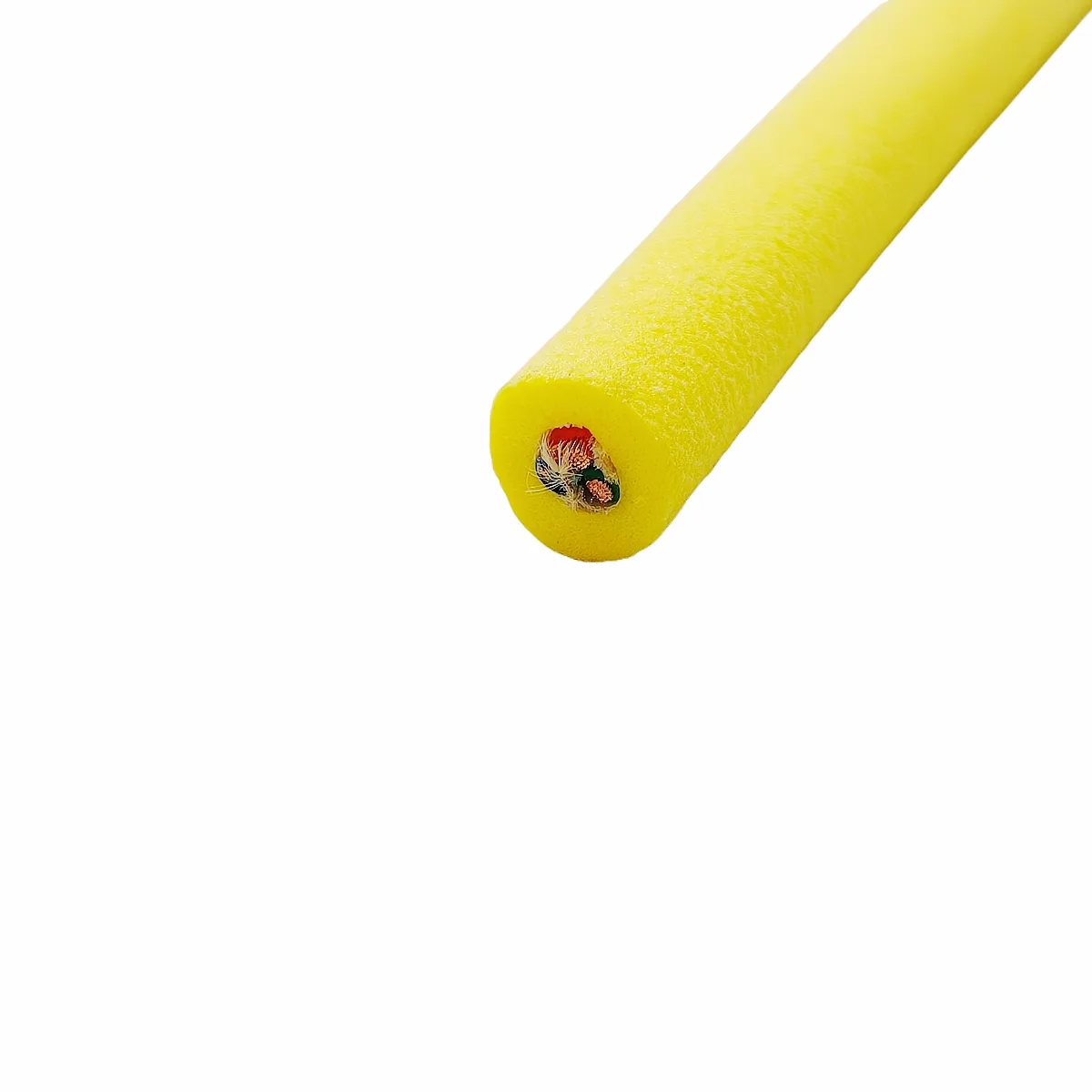
Single-sheath zero-buoyancy cable 2×0.75mm²+1×2×0.2mm²
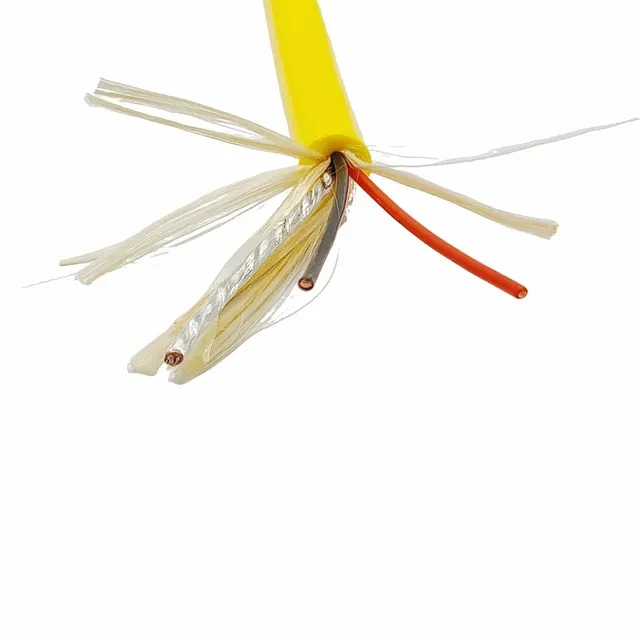
Single-sheath zero-buoyancy cable with two 0.75mm² power cores and one 0.2mm² data pair, PE insulation, foil-wrapped pair, foamed TPU sheath, 8.4mm OD.
Product overview
The zero-buoyancy cable is a transmission cable commonly used on underwater working equipment. Its design aim is neutral buoyancy in water — neither rising nor sinking — so that cable weight has less effect on equipment attitude, deployment depth and handling feel. The construction described here is a single-sheath zero-buoyancy cable that integrates two power cores and one data pair in one cable, so power supply, signal and data return are handled together and fewer cables are needed on the underwater equipment. The outer sheath is foamed thermoplastic polyurethane (TPU) in yellow for underwater observation and identification. Cross-section, wall thicknesses, outer diameter and the buoyancy control method work together; the values are listed in the Main construction parameters section, and the other sections describe the design qualitatively. Supply specifications are as stated in the specification document confirmed by both parties.
Conductor and power core construction
The power core conductor is a bunched bare copper stranding; nominal cross-section per core, stranding type, lay direction and stranded diameter are given in the Main construction parameters section. Stranding many fine wires gives the conductor good bending performance while maintaining current-carrying capacity, so individual wires are less likely to fail from fatigue when the cable is repeatedly coiled and deployed, which matters especially for equipment launched and recovered often. A bunched conductor has an even diameter and a round surface, which allows uniform insulation coverage and makes dimensional control easier when stripping and crimping terminations.
Insulation and core identification
The power cores are insulated with polyethylene (PE); insulation thickness and core diameter over insulation are given in the Main construction parameters section. The two power cores are red and green for termination work and wiring checks. Polyethylene has a low dielectric constant and stable insulation resistance, which suits low and medium voltage subsea power circuits; its low water absorption also means insulation performance degrades slowly in damp or permanently immersed conditions, which helps extend service life. The extruded insulation bonds tightly to the conductor, limiting water ingress along the conductor-to-insulation interface.
Data pair and shield construction
The data section is one pair of data cores with stranded bare copper conductors; the two cores are blue and blue-white and twisted as a pair under an aluminium foil wrap. Cross-section and conductor construction are given in the Main construction parameters section. Pair twisting improves common-mode interference rejection, and the foil wrap provides electrostatic shielding for the pair, suppressing coupling from the power circuit so that sensor data and control commands remain stable over longer subsea distances. Where a signal pair shares a cable with power cores, shield continuity and earthing also affect communication quality, and the foil should be carried through intact when terminating.
Cabling, strength member and water blocking
Power cores and the data pair are cabled with a left-hand lay. High-strength fibre is added as the strength member, water-blocking yarn is included, and a non-woven tape holds the assembly together; the number and size of the fibres, the number of water-blocking yarns and the cabling details are given with the construction parameters. The reinforcing fibre carries the tensile load during deployment and recovery, so that under suspension and towing the load is taken mainly by the fibre rather than the conductors, protecting conductors and insulation. The water-blocking yarn swells on contact with water and blocks longitudinal seepage through the interstices of the core, while the non-woven tape keeps the core round and stable and gives the extruded sheath an even base.
Outer sheath and buoyancy control
The outer sheath is foamed thermoplastic polyurethane (TPU) applied by pressure extrusion; sheath thickness and finished outer diameter are given in the Main construction parameters section. The foamed layer contains uniform cells that reduce the apparent density of the material, and by adjusting the degree of foaming the overall density of the cable is brought close to that of water, giving zero, that is neutral, buoyancy — neither rising nor sinking in water. TPU itself offers good abrasion resistance, oil resistance and hydrolysis resistance, which suits frequent deployment and long-term subsea use. The yellow sheath is clearly visible in water for observation and recovery.
Key features
- Combined power and signal: two power cores and one data pair complete power supply and signal transmission in a single run.
- Zero-buoyancy design: the foamed outer sheath adjusts overall density and reduces the effect of cable weight on the attitude and handling of underwater equipment.
- Tensile strength and water blocking: high-strength fibre carries the load and water-blocking yarn interrupts the longitudinal seepage path.
- Interference rejection: the data pair is twisted and foil-wrapped, suppressing interference from the power circuit.
- Flexible and durable: stranded fine-wire conductors and a foamed TPU sheath combine bending performance with abrasion and water resistance.
- Compact construction: power cores, data pair, strength and water-blocking elements share one cable, and the round profile eases bulkhead passage and connector assembly.
Main construction parameters
- Power core cross-section: 2×0.75mm².
- Power core conductor: bare copper, bunched multi-wire stranding, left-hand lay, stranded diameter approx. 1.12mm.
- Power core insulation: polyethylene (PE), 0.35mm thick, core diameter 1.8mm, red and green.
- Data pair: 1×2×0.2mm², multi-wire stranded bare copper conductor, cores in blue and blue-white.
- Data pair shield: aluminium foil wrap.
- Cabling: left-hand lay.
- Strength member: 4 × 3000D high-strength fibres.
- Water-blocking element: 2 water-blocking yarns.
- Tape: non-woven fabric.
- Outer sheath: foamed thermoplastic polyurethane (TPU), yellow, pressure extrusion, sheath thickness 2.2mm.
- Finished outer diameter: 8.4±0.3mm.
Typical applications
- Power and signal transmission for underwater vehicles and subsea propulsion units
- Combined power and data connection for subsea cameras, lighting and pan-and-tilt units
- Signal links between subsea sensors, survey instruments and surface control units
- Underwater work where neutral buoyancy is needed so that cable drag does not affect equipment attitude
- Equipment deployment in pools, lakes and coastal waters from shallow to medium depth
Selection and customisation notes
- Power core cross-section and core count can be adjusted to equipment power and supply distance, and the data pair can be changed to suit the signal type and transmission requirement.
- Buoyancy can be adjusted to the water area of use; where slightly positive or slightly negative buoyancy is required, the degree of foaming and the structural proportions can be designed accordingly.
- Length, sheath colour, surface marking method and end preparation can all be customised to project requirements.
- For long-term subsea use, confirm the working depth, bending radius and deployment method in advance so that the strength elements and sheath can be matched at the design stage.
- The above is a typical construction; the final supply specification is as stated in the specification document confirmed by both parties.
Related in Zero-Buoyancy Cables
 Buoyant cable 3x0.75+STP CAT6
 Buoyant cable, single sheath, 1-core fibre, 200 kg tensile
 Double-layer neutrally buoyant cable 2×14AWG+24AWG+1SMF
 Double-layer zero-buoyancy 2×0.75 + (1×2×0.2)P
Engineering enquiry