PDK21303-3×120+2×70/2+12G6×2.5/125 Crane Drum Cable, 0.6/1kV, 57mm
Crane & Hoist Drum Cables · Industrial Automation
PDK21303
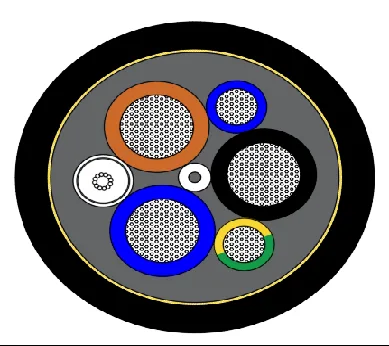
Crane drum cable combining 120mm² power cores with a 12-core multimode fibre unit, steel rope centre member, NBR and TPU sheath, 0.6/1kV, 57mm OD.
Product overview
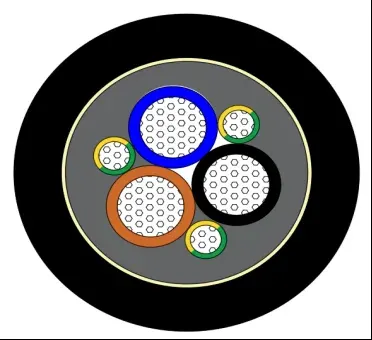
PDK21303-3×120+2×70/2+12G6×2.5/125 is a composite cable developed by PAIDE for cranes, gantry travelling cranes and drum reeling systems. It integrates large cross-section power conductors and a multi-core multimode fibre unit in one cable, so power and optical signals are transmitted together as the drum pays out and reels in. This reduces the routing difficulty and space taken by several parallel cables on site, and cuts the number of joints and the potential failure points they create.
Unlike a cable in fixed installation, a drum cable continuously carries reeling tension, compression between wound layers and bending over sheaves, so this type has been designed specifically in its conductor stranding, inner sheath, braid strength layer and outer sheath. Cable-level values such as rated voltage, rated temperature and minimum bending radius are given in the Electrical performance section, while conductor and layer dimensions and the finished outer diameter are given in the Construction and materials section.
Construction and materials
Conductors are bare copper. The main power cores are 120mm², built up from fine copper wires in a layered re-stranding, with a stranded diameter of approximately 16±0.2mm; the auxiliary cores are two groups of multi-wire stranded conductors with a stranded diameter of approximately 9.2±0.2mm. Re-stranding fine wires distributes load more evenly across the individual wires during repeated bending, which is the key to service life in drum applications; layered re-stranding also keeps a large cross-section conductor reasonably flexible in bending and reduces the chance of wire breakage from concentrated stress.
For insulation, both power and auxiliary cores use PVC, with average thicknesses of 2.0mm and 1.2mm, minimum thicknesses of not less than 1.6mm and 1.0mm, insulation diameters of approximately 20±0.2mm and 11.5±0.2mm, and colours of blue, brown and black, and blue with yellow-green, so that phases and earth are easy to distinguish on site. Another insulation group in the specification uses NBR, with an average thickness of 1mm, a minimum thickness of 0.85mm, an insulation diameter of approximately 10±0.2mm and a black colour. Insulation thickness and material together determine the temperature rating and voltage withstand of the cable, so in drum duty both flexibility and insulation margin have to be considered.
The centre load-bearing section contains a 3mm diameter steel wire rope covered with a 6.3mm PVC sheath, forming a separate central strength unit that takes the longitudinal pull during reeling and keeps it off the conductors and fibre unit. Because the strength member is separate from the conductors, the conductors are not stretched out of shape over long service and the fibre unit stays in a more stable condition.
The inner sheath is black NBR, with an average thickness equal to that of the power core insulation, a minimum thickness of 1.7mm and an inner sheath diameter of 50±1.0mm. Over it is a Kevlar aramid braid strength layer at approximately 50% coverage, which further improves tensile and torsional strength. The outer sheath is black TPU, with an average thickness of 3.5mm, a minimum thickness of 3.0mm and a finished outer diameter of 57±2.0mm. TPU performs consistently in abrasion resistance, tear resistance, oil resistance and weathering, which suits lifting equipment used outdoors or in oily and dusty conditions over long periods.
Key features
- Load-bearing construction: a central steel wire rope and a Kevlar aramid braid form a dual load path for the continuous longitudinal pull of drum operation, so conductors and fibre unit carry no direct tension;
- Abrasion and drag resistance: the TPU outer sheath with an NBR inner sheath relieves friction losses between wound layers and against guide sheaves;
- Temperature adaptability: the sheath stays flexible during cold starts and does not soften readily at higher ambient temperature, which suits sites with wide indoor and outdoor temperature swings;
- Bending performance: the small bending radius requirement allows long-term reeling on drums and sheaves of small diameter, which suits equipment with restricted installation space;
- Combined transmission: power cores and a multimode fibre unit are formed in one cable, so a single installation meets both power supply and signal return needs and simplifies the layout of drag chain or drum systems.
Electrical performance
The cable is rated 0.6/1kV with a rated temperature range of -40℃~+90℃ and a minimum bending radius of 8D (D being the cable outer diameter). The wide temperature range keeps the sheath flexible during cold starts and at higher ambient temperature, while the small bending radius allows long-term reeling on drums and sheaves of small diameter, which suits lifting equipment with tight cable routes.
At 20℃ the maximum conductor DC resistance is approximately 0.161 Ω/km for the main power cores and approximately 0.554 Ω/km for the auxiliary cores. These are maximum permitted values and can be used directly for voltage drop and current capacity calculations, with a suitable margin recommended. The fibre unit is a twelve-core multimode construction; attenuation, bandwidth and other optical values can be provided to project requirements. Sheath printing covers company name, specification, date and metre marking, and the legend and layout can be adjusted to purchasing requirements. Where power and optical signals share one cable, conductor cross-section and fibre parameters should be confirmed together at the system design stage, so that the power side is adequate without leaving insufficient margin on the signal side.
Typical applications
The type is used for power and signal transmission on port and terminal gantry cranes, container handling equipment, workshop travelling cranes and electric hoists, drum-reeled grabs and spreaders, stacker-reclaimers, and heavy material handling equipment in metallurgy and building materials. Where power and optical signals such as video and control have to be transmitted while the long-travel motion runs, one composite cable simplifies the drag chain or drum layout and reduces the number of joints and maintenance points.
On such equipment the power and signal circuits usually follow the same route. Using separate power and fibre cables means laying several cables in parallel in the same drag chain or on the same drum, which takes space and adds installation and maintenance work. With a combined power and fibre construction only one cable is needed in the reeling system, so guide and fixing points are fewer and routine inspection is concentrated on one item, which matters particularly for continuous-duty port and metallurgy equipment.
Related types in the same series
The same product family includes several specifications for reference: PDK21301-3×70+3×16 for crane drum power transmission, with the same rated voltage and temperature range as the main type and a minimum bending radius of 10D; PDK21302 4×10AWG with EPDM insulation and NBR inner and outer sheaths, rated 600V, temperature range -40℃~+105℃, finished outer diameter 19.1±0.5mm and a bending radius of 7 to 10 times the outer diameter; PDK21303-3×240+3×120/3 and PDK21303-3×70+3×35/3, large cross-section specifications in the same series with the same rated voltage and minimum bending radius as the main type; and PDK21303-48×2.5, a multi-core small cross-section construction rated 300/500V with the same bending radius as PDK21301. For a medium-voltage drum cable, PDK91300 3×35+2×12.5+12MMF is rated 6/10kV with a minimum bending radius of 15D and also contains a multimode fibre unit.
These types differ in core count, cross-section and fibre configuration. When selecting, establish the main construction from the power capacity and number of signal channels of the equipment, then check drum diameter, operating environment and installation method to confirm sheath material and strength arrangement, verifying the detailed data of the relevant series type where necessary.
Customisation and ordering notes
Selecting a drum cable requires drum diameter, reeling length, travel speed, maximum tension, number of simultaneous bends, and the temperature, oil contamination and humidity of the environment. The construction data above is taken from the specification of this type; supply can be adjusted for conductor cross-section and core combination, fibre count and type, sheath material (such as NBR or TPU), tensile reinforcement, outer diameter tolerance and print legend. For drum diameters or tensile requirements outside the normal range, confirm the working conditions first and then determine bending radius and strength construction, so that the cable performs reliably over its expected life. Detailed data for similar specifications can be checked against the series types in the catalogue.
When selecting an optoelectric cable, note that the bending radius requirements of the power circuit and the optical circuit are not identical, and the installation radius is normally set by the stricter of the two; the fibre connector type and splicing method should also be confirmed, together with whether the handling mechanism at the equipment end has sufficient space margin. If the equipment runs for long periods in damp, dusty or oily conditions, state this at the time of order so that the sheath material and strength layer can be adjusted accordingly.
Related in Crane & Hoist Drum Cables
 Crane drum cable 7×14AWG+10×18AWG
 Drum cable 4×4 + 2.5 + 4-core network
 Drum cable 7x14AWG+8x18AWG+1x2x22AWG
 PDK21301
Engineering enquiry