Tethered Drone Cable 4x0.8 mm², 10-15 A, Aramid Braid
Tethered Drone Cables · Tethered Systems
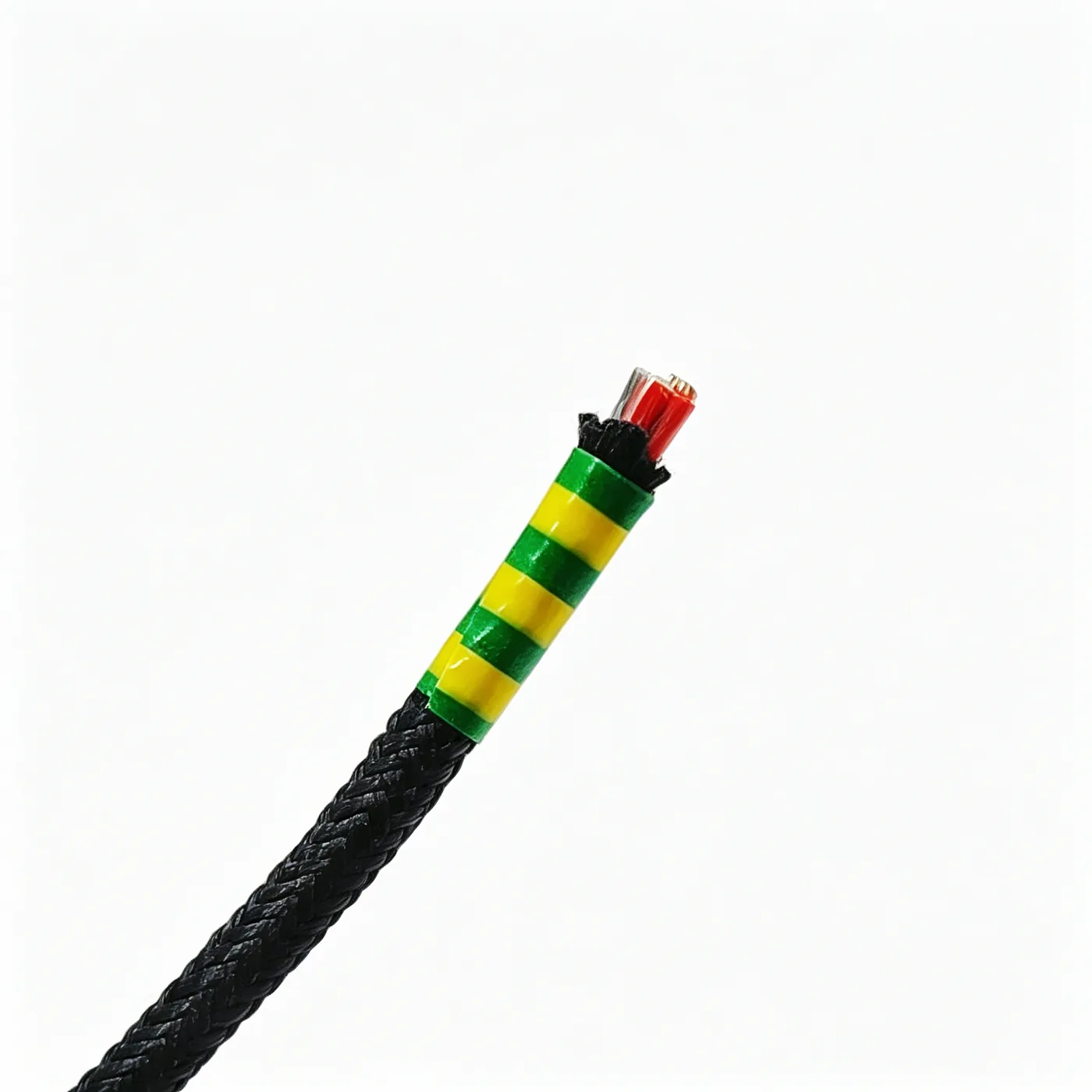
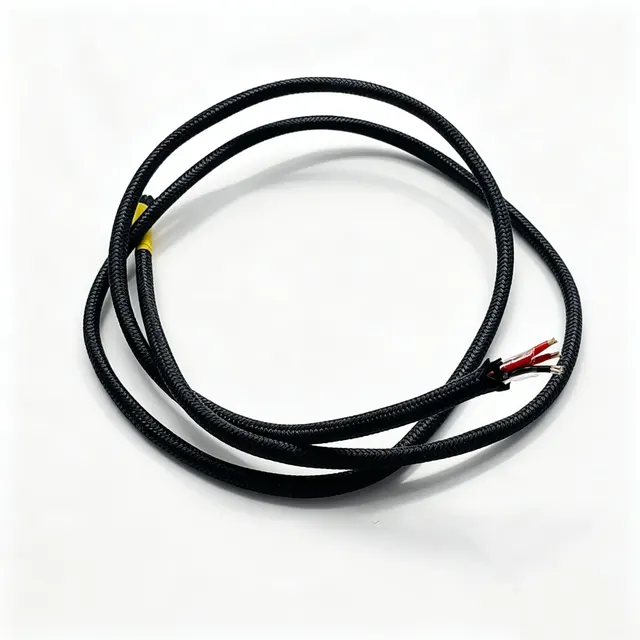
Tethered cable 4x0.8mm² 10-15A
Lightweight tethered drone cable with four 0.8 mm² alloy copper cores, FEP insulation, central LCP strength yarns and aramid braid, 10-15 A.
Product overview
A tethered drone draws continuous power from a ground unit so that it can hover and work for long periods on tasks such as lighting, communication relay, reconnaissance and monitoring, and emergency response. This duty places concentrated requirements on the tether: the supply circuit needs enough conductor cross-section to keep line voltage drop and temperature rise within limits over a long run; the cable should be as light as possible, because its weight directly reduces payload and endurance; and because the cable is repeatedly payed out and recovered, the outer layer must resist abrasion and bending and provide a certain tensile capacity.
This tether is a lightweight tethered cable designed for such duties. It combines power cores, strength members and a braided outer layer in one cable: the conductor is copper alloy, the insulation a fluoropolymer, a strength yarn is placed at the center of the cable to take the tensile load, and the outermost layer is a high-strength fiber braid. This maintains supply capability while keeping the weight and diameter of the whole cable small, making it suitable for a long-term continuous link between an airborne power unit and a ground supply.
Construction and materials
- Conductor: stranded copper alloy, 4x0.8 mm²
- Insulation: FEP, 0.25 mm thick, single insulated core diameter 1.55 ±0.08 mm
- Color coding: two black and two red cores, for identifying polarity and circuits on site
- Cabling: four cores cabled left-hand, cabled diameter 3.8 mm
- Strength member: 2 × 3000D LCP strength yarns at the center of the cable, cabled together with the cores; tensile load is carried mainly by the yarns and the conductors do not take the main pull
- Tape: polyester tape wrapping, to compact the cabled construction and keep the cores from loosening
- Outer sheath: black aramid fiber braid, no extruded sheath; 2 × 800D yarns plied, 16-carrier braid, coverage approx. 98%
The copper alloy conductor balances conductivity and mechanical strength and does not break strands easily under repeated bending. FEP insulation gives stable temperature and dielectric performance, and the thin wall keeps the single-core diameter down while leaving margin for weight reduction. The two LCP strength yarns at the center are the main load path of this construction; placed at the geometric center, they control the elongation of the whole cable under load. Polyester tape wrapping binds the four cores and the strength yarns into a round unit for the subsequent braid.
The outer aramid braid also serves as the sheath: it encloses and protects the inner cores and provides an abrasion- and cut-resistant surface that takes the friction of the pay-out mechanism and the ground directly. Because there is no extruded sheath, the cable has a smaller diameter and lower weight for the same tensile requirement.
Key features
- Low weight: conductor, insulation and strength members are configured with weight as the priority, so the finished weight per meter is low and the effect on aircraft payload is limited
- Load bearing separated from conduction: tensile load is carried by the central strength yarns and the braid, while the power conductors only carry current
- Smooth pay-out: four cores cabled left-hand with a round central fill, so the cable does not knot or take a permanent kink during pay-out and recovery
- Abrasion and weather resistant: the braided outer layer contacts the pay-out mechanism and the ground directly and resists abrasion and cutting
- Compact construction: power cores and strength members share one cable, so a single cable both supplies power and carries load
- Easy identification: two black and two red cores make connection quick to identify
Electrical and mechanical performance
The electrical performance of the cable depends on conductor cross-section, insulation thickness and cabled construction, and the mechanical performance on strength yarn specification and braid density; both can be adjusted to the actual duty when the project is confirmed. Voltage class, temperature range and minimum bending radius are determined by the service conditions and are subject to the specification file confirmed by both parties.
Typical applications
- Continuous power for long-endurance tethered drones, supplied from a ground unit through the cable
- Ground power supply and signal transmission for aerostats and tethered balloons
- Fixed-point platforms for emergency communication relay, long-duration lighting and video monitoring
- Mobile tethered systems requiring frequent take-off and landing and repeated pay-out
- Airborne supply circuits where cable weight matters but continuous power is required
In these duties the cable is repeatedly pulled by the pay-out mechanism together with the platform; the abrasion resistance of the outer braid and the stability of the strength yarns determine service life, and because the cable carries current continuously, conductor cross-section and insulation thickness must match the actual current and supply distance.
Selection and customization notes
- Core count and conductor cross-section: cores can be added or the cross-section adjusted to the current demand
- Current rating: determined by supply distance and permitted voltage drop
- Tensile capacity: strength yarn specification and braid configuration selected to the required pull
- Outer covering: braid color and material can be confirmed to project requirements
- Pay-out equipment: recommendations can be provided for drums, winches and connector arrangements
- Other electrical and mechanical values: subject to the specification file confirmed by both parties
PAIDE can provide tether construction design, prototype samples and series supply to project requirements; final specifications and technical values are subject to the specification file confirmed by both parties.
Related in Tethered Drone Cables
 2×20AWG
 7×0.5
 Drone cable 2x22AWG+2x1 fiber
 Drone cable 4×1.2
Engineering enquiry