PDK81301-4×2×0.2mm²-500KG Watertight Subsea Signal Cable, 9.9mm
Watertight Optoelectric Cables · Marine & Subsea
PDK81301
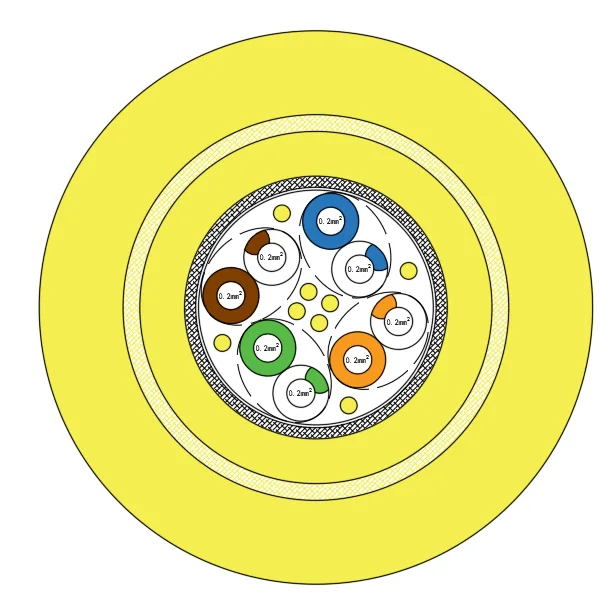
Watertight signal cable with four 2-core 0.2mm² units, PE insulation, 80% tinned copper braid shield, double polyurethane sheath, 500kg tensile rating.
Product overview
PDK81301-4×2×0.2mm²-500KG is a high-tensile subsea signal cable in the PAIDE watertight cable range. The type is cabled from four two-core signal units and is designed around the subsea operating environment, built on bare copper conductors, PE insulation, a tinned copper braid shield and a double watertight polyether polyurethane sheath, with an LCP braid strength layer between the inner and outer sheaths. The shielding system gives low-level signals a comparatively clean transmission path, while the strength layer lets the cable withstand high longitudinal tensile load and repeated flexing without sacrificing the flexibility of the cores.
In use, subsea signal circuits face two main difficulties: damp and immersed conditions impose watertight requirements on materials and construction, and equipment-dense layouts with parallel power lines tend to introduce electromagnetic interference into low-level signals. This type addresses both in its construction — a double watertight sheath keeps moisture out and a braided shield suppresses external interference, while a separate strength structure takes the pull so that signal cores are not directly loaded during installation and deployment. Reference standards are to customer requirement, and the product serves subsea wiring where watertightness, tensile strength and interference immunity are all required.
Construction and materials
Conductor and insulation
Core conductors are stranded bare copper with a multi-wire stranding, a stranded diameter of approximately 0.61mm and a nominal cross-section of 0.2mm² per core. Stranding gives the conductor flexibility while maintaining conductivity, which eases cabling and repeated bending and reduces the difficulty of terminating caused by conductor spring-back on site. Insulation is PE with an average thickness of 0.2mm, a minimum thickness of 0.17mm and an insulation diameter of approximately 1.0mm; PE has stable dielectric properties and low water absorption, which suits signal cores in permanently damp conditions.
The four units are identified by colour combinations of orange and orange-white, blue and blue-white, green and green-white, and brown and brown-white. Circuits can be identified quickly by colour during connection and maintenance, which reduces miswiring and allows signal paths to be checked unit by unit on site, particularly on subsea equipment with many termination points and little service space.
Shield construction
A tinned copper braid shield with 80% coverage is applied over the core, giving effective protection against external electromagnetic interference and helping low-level signals transmit reliably in equipment-dense subsea environments with parallel power lines. The tinned layer also limits oxidation of the copper to a degree, which helps keep the earth return reliable over time. Shield material and braid coverage can be adjusted to the actual interference level for different electromagnetic environments; where interference sources are close or signal levels are low, describe the installation conditions at the selection stage so that the shielding can be assessed.
Fillers and strength members
To keep the core round and share longitudinal load, 8 × 3000D LCP yarns are used as fillers inside the core, and a strength layer braided from 16 LCP yarns of the same size is placed between the inner and outer sheaths. That layer is the main load-bearing structure and gives the cable a nominal tensile strength of 500kg. Because the load-bearing layer sits separately between the sheaths, longitudinal pull is taken mainly by the braid and the signal cores carry no direct tensile load, so they keep stable electrical performance and geometry while under tension. The number of fillers and strength yarns and the braid pattern change with core count and cross-section; the final configuration is as stated in the confirmed specification.
Double sheath
The inner and outer sheaths are both watertight polyether polyurethane, in yellow. The inner sheath has an average thickness of 0.8mm and gives a core diameter of approximately 6.3mm; the outer sheath is extruded over the strength braid with an average thickness of 1.5mm, a minimum thickness of 1.28mm and a finished diameter of approximately 9.9mm. Polyether polyurethane has good hydrolysis resistance, and together with the double watertight construction the cable withstands damp and immersed conditions over long periods; the sheath remains mechanically stable and its surface does not crack or become tacky from moisture attack.
The sheath is printed by default with the company name, type designation, production date and metre marking, which allows batch checking and measurement of installed length on site. The yellow outer sheath is easy to see under water and in turbid water, which helps when observing cable routing and condition during deployment.
Key features
- High tensile strength: the cable has a high nominal tensile capacity, and the load-bearing layer is separate from the signal cores, so pull is taken mainly by the LCP braid and the cores take no direct load.
- Wide temperature range: the rated operating temperature covers both cold and hot extremes, so the construction stays stable during cold starts and where equipment generates heat.
- Bending performance: the minimum bending radius is controlled as a fixed multiple of the finished outer diameter, which eases routing around bends inside equipment bays and narrow passages; following it during deployment and coiling reduces damage to sheath and cores.
- Watertight rating: the cable has a nominal transverse subsea pressure rating, which can be used to assess the depth conditions it suits, in consultation with PAIDE and the actual installation condition.
- Signal shielding: a tinned copper braid shield at high coverage suppresses external electromagnetic interference and protects signal quality.
- Colour identification: units are identified by paired colours, and with the yellow outer sheath this eases on-site wiring and underwater observation.
Electrical performance
The rated voltage is 300V, which suits low-voltage signal circuits. At 20℃ the maximum DC resistance of a core at nominal cross-section is 84.1 Ω/km, which can be used to estimate line loss over long runs and to support system design. Final acceptance of each electrical value is as stated in the specification confirmed by both parties.
Environmental and mechanical values are given in the same section: the rated operating temperature is -40℃ to +105℃, covering cold and hot working environments; the minimum bending radius is approximately 10 to 12 times the cable outer diameter, which suits installation in restricted space; and the transverse subsea depth rating is nominally 5MPa, which can be used to assess suitable depth conditions. These values are interrelated, so selection should consider installation method, tensile condition and available space together rather than a single parameter.
Typical applications
The type is aimed at signal transmission in subsea and high-humidity environments, typically for signal circuits in underwater working equipment, sensor connections on monitoring devices, and engineered harnesses that must be watertight, tensile and interference-resistant at the same time. Where space inside equipment bays is limited and cable routes are narrow, the small bending radius allows bends and fixing; where long-term immersion or frequent deployment is involved, the double sheath and strength construction maintain long-term reliability and reduce maintenance frequency.
The type contains no power or fibre units, so it suits cases where the signal circuit is relatively independent and the load is clearly defined. If the same route also needs power or fibre communication, other power or optoelectric watertight cables from the PAIDE range can be combined, with the overall installation assessed by engineering staff. To confirm suitability for a project, provide working depth, temperature, bending radius, tensile load and installation method so that the configuration can be evaluated.
Customisation and ordering notes
The type is made to customer requirement: conductor cross-section, number of core pairs, sheath colour, length and print legend can be adapted to the project, and shield coverage and strength layer configuration can be agreed according to interference level and mechanical load. When ordering, provide working depth, ambient temperature, tensile load, minimum bending radius and termination type at both ends so that a suitable specification can be matched and the design confirmed more quickly.
If the route passes through structures with many bends, or the cable is to be suspended for long periods and deployed frequently, also describe the motion and load conditions so that the strength layer and sheath configuration can be checked for margin. The parameters listed here are taken from the specification sample; values not covered can be supplied on request or verified by separate design testing, and reference standards are applied to customer requirement.
Related in Watertight Optoelectric Cables
 4×2×24AWG (UTP) + 2×14AWG + 2×12AWG
 Custom
 Longitudinally watertight cable 2×22AWG+STPCAT6-100KG
 PDK81301
Engineering enquiry