Watertight Optoelectric Cable 2×14AWG+STP CAT5, Double Shield, OD 10.8 mm
Watertight Optoelectric Cables · Marine & Subsea
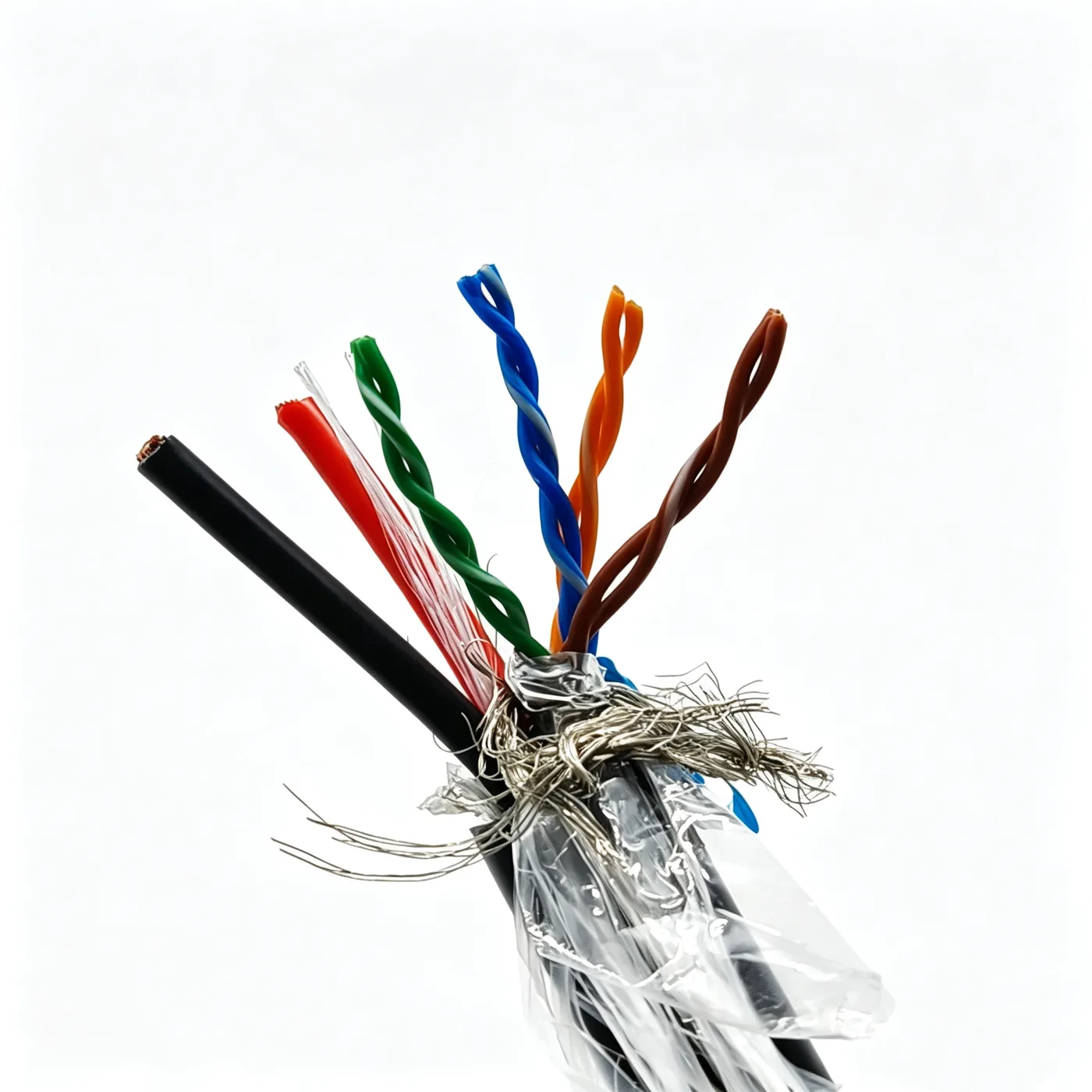
Watertight cable 2×14AWG+STP CAT5
Watertight composite cable pairing two 2.08 mm² power cores with a shielded CAT5 element, aluminium foil plus braid and TPU sheath; OD 10.8 mm.
Product overview
The watertight cable 2×14AWG+STP CAT5 combines power cores with a shielded twisted pair network cable under one sheath, so a single cable carries both power transmission and Ethernet data return, reducing the number of hull penetrations, connectors and wiring runs on underwater equipment. The core is designed for watertightness: the gaps in the cabling are filled with compound, wrapped with non-woven fabric and then covered by an extruded outer sheath, so the cable keeps a stable round section when immersed. The conductors, insulation and shielding of the power circuit and the network cable are designed separately for their different duties and then cabled together, balancing the current-carrying capacity of the power path with the structural stability the network cable needs. This construction suits applications that involve long-term or repeated immersion and require both power and network communication, such as underwater vehicles and subsea tooling, marine observation and hydrological monitoring equipment, underwater camera and lighting systems, and power and signal connections in tanks and test rigs.
Construction and materials
- Conductor: bare copper strands
- Network cable conductor: bare copper strands
- Insulation: PE, 0.4 mm thick
- Outer sheath: TPU, 1.5 mm thick, black
The power section has two cores with a nominal cross-section of 2.08 mm² each. Insulation is PE with an insulation diameter of 2.8 mm, and the two cores are coded red and black for polarity so that wiring and inspection are quick to identify. The two insulated cores are cabled together with the network cable, and the cabling construction and filler hold them in position so that no core shifts loose in service.
The network section consists of 4 twisted pairs with a nominal conductor cross-section of 0.2 mm² (24AWG). The four pairs are matched as blue/white-blue, orange/white-orange, green/white-green and brown/white-brown, each pair twisted separately so that the different lay lengths reduce crosstalk between pairs. Pair twisting is itself the basis for suppressing common-mode interference, and the four pairs are arranged in a fixed sequence so that the network element keeps stable transmission conditions inside the composite cable.
Shielding is applied after the pairs are twisted: aluminium foil is wrapped with the metal side facing out, then covered with tinned copper braid at 80% coverage, and a polyester tape is wrapped on the outside for separation and fixing, forming a two-layer aluminium foil plus braid shield. The foil mainly blocks high-frequency interference, while the braid provides lower earthing resistance and better mechanical protection and also holds the core shape so that the following cabling process keeps it round.
The shielded network cable is cabled together with the two power cores to a cabling diameter of 7.8 ± 0.3 mm; the gaps are filled with PP filler and the outside is wrapped with non-woven fabric, so the core is loaded evenly and the path for water to seep longitudinally between cores is reduced. The outermost layer is an extruded TPU sheath giving a finished outer diameter of 10.8 ± 0.3 mm. The sheath bonds tightly to the core, so the sheath and core do not separate during deployment, retrieval and towing.
Key characteristics
- Power and data combined: one cable carries both power and Ethernet signals, reducing penetrations and connector interfaces
- Double shielding: aluminium foil wrap plus tinned copper braid gives good suppression of electromagnetic interference
- Longitudinal water blocking: filled cabling gaps, non-woven wrap and an extruded sheath hinder water seeping between cores
- Sheath performance: TPU is abrasion and oil resistant and suits underwater towing and repeated deployment
- Flexible and easy to install: stranded conductors and an elastic sheath make the cable easy to bend, coil and route
- Compact construction: power and network share one cable and one sheath, which simplifies wiring in confined equipment spaces
Electrical and mechanical performance
- Electrical values: rated voltage, withstand voltage and insulation resistance are determined by project requirements and subject to the specification document confirmed by both parties
- Conductor: stranded fine copper wires with good bending behaviour, suitable for repeated deployment and coiling at small radii
- Shield continuity: foil and braid together form the shield circuit, reducing the effect of external electromagnetic interference on the network signal
- Shielding and tensile load: the tinned copper braid also takes part of the pulling force during installation, protecting the network element from being stretched
- Watertightness: watertightness relies on the overall structure formed by gap filling and the extruded sheath; joint and termination methods must match the cable construction
- Environmental suitability: operating temperature range and minimum bending radius are subject to the specification document confirmed by both parties
Typical applications
- Power and data links for underwater vehicles and subsea tooling
- Data return for marine observation, hydrological monitoring and underwater sensor networks
- Power and network connections for underwater cameras, lighting and inspection equipment
- Composite wiring in tank test rigs and underwater test equipment
- Other applications requiring simultaneous power and Ethernet communication with a water-immersion-resistant cable
Selection and customisation notes
- Power core cross-section and core count, number of network pairs and shielding method, sheath material and colour, finished outer diameter and length can be adjusted per project
- Core arrangement, shield construction and appearance colour can be agreed according to installation space and operating environment
- Where higher tensile or torsion resistance is required, the need for additional strength construction can be assessed together with the installation method
- Where underwater connectors, joints or termination are required, the connection method and mating dimensions should be confirmed first, subject to the specification document confirmed by both parties
- Provide the operating environment, installation method and electrical and mechanical requirements and a suitable specification can be assessed on that basis
Related in Watertight Optoelectric Cables
 4×2×24AWG (UTP) + 2×14AWG + 2×12AWG
 Custom
 Longitudinally watertight cable 2×22AWG+STPCAT6-100KG
 PDK81301
Engineering enquiry