Watertight Optoelectric Hybrid Cable 2x1.0 mm2 + 3x2x0.2 mm2 + RG316, 12.5 mm
Watertight Optoelectric Cables · Marine & Subsea
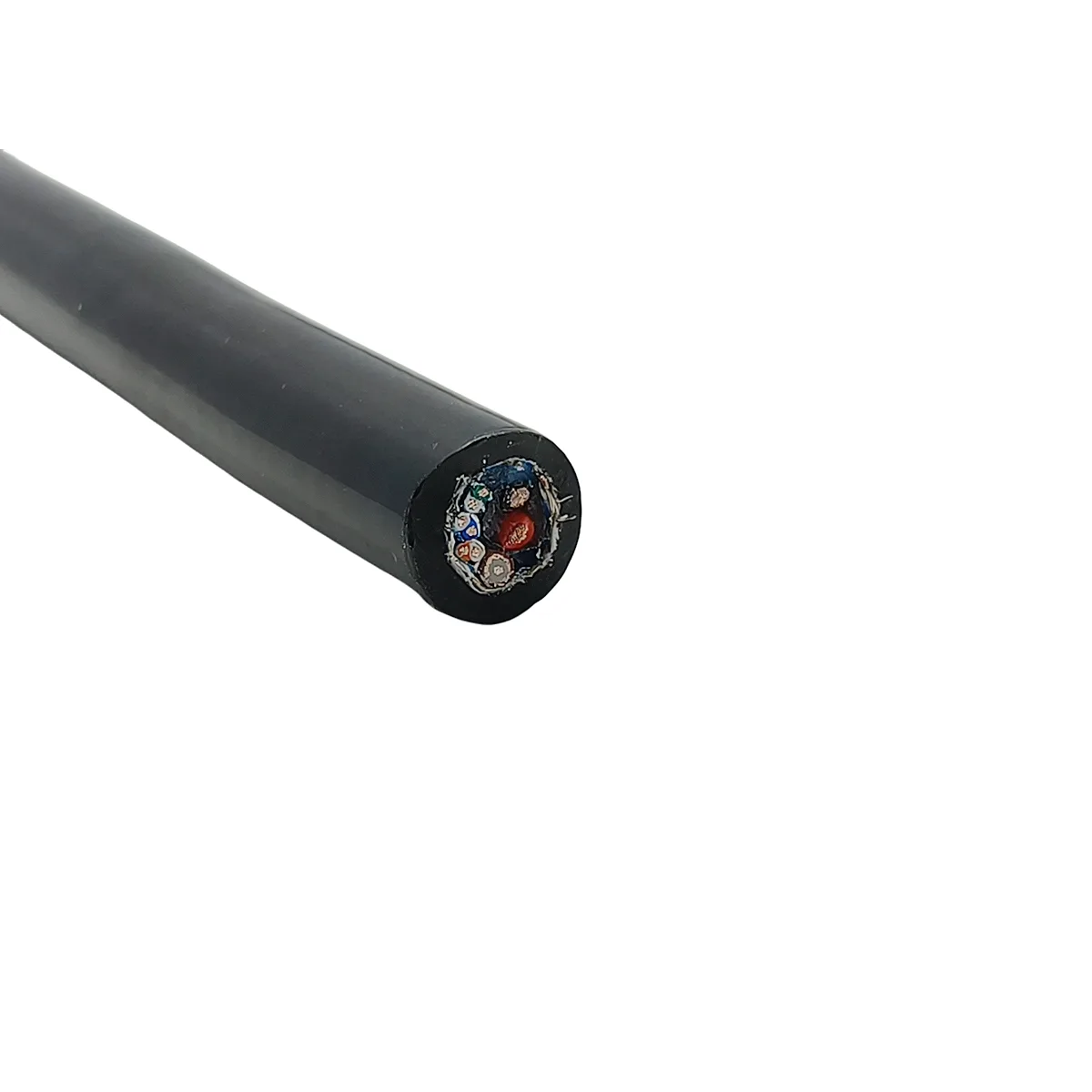
Watertight cable 2x1.0 mm2 + 3x2x0.2 mm2 + RG316
Watertight hybrid cable: 2x1.0 mm2 power pair, three 0.2 mm2 signal pairs and one RG316 coaxial unit, layered foil and braid shield, TPU sheath, 12.5 mm.
Product overview and use
The watertight optoelectric hybrid cable described here combines one power pair, three twisted signal pairs and one RF coaxial unit in a single cable. Each unit is individually shielded before cabling, and the assembly is then given an overall braided shield and a non-woven wrap, with a black TPU sheath on the outside. This hybrid construction allows subsea equipment to receive power, control signals and RF signals through one cable, reducing the number of harnesses on the equipment, the number of subsea connectors and the number of hull penetration seals.
The core uses a filled construction: the gaps between the power pair, signal pairs and coaxial unit are filled with PP rope, and aluminium foil is longitudinally wrapped over the cabled core so that the cross-section is as dense as possible and longitudinal water paths are unlikely to form. For applications involving long-term immersion or repeated deployment, this construction helps maintain the roundness and suppleness of the cable and keeps the bending shape stable during spooling and unspooling.
Running power and signal circuits in parallel within one cable is the main issue a hybrid cable must address. In this product each signal pair has its own aluminium foil shield, an overall tinned copper wire braid is added after cabling, and the power and signal pairs are individually twisted, reducing coupling between circuits so that signals of different types can be transmitted in the same cable.
Construction and materials
- Conductor: tinned copper,
- Insulation: PP, thickness 0.4 mm
The power cores are stranded from tinned copper wires, with a nominal cross-section of 1 mm² per core, left-hand lay and a stranded diameter of 1.3 mm. The tin coating inhibits oxidation of the copper and facilitates soldering and crimping at the ends.
- Power pair: two insulated cores, black and red, twisted together, with PP rope filler at the twist and longitudinal aluminium foil.
- Signal pairs: three groups, each with two insulated cores — blue/white, orange/white and green/white twisted pairs; each group is longitudinally wrapped with aluminium foil to form a relatively independent signal channel.
- Cabling: the power pair, signal pairs and coaxial unit are cabled in sequence with left-hand lay to a cabled diameter of 8 ± 0.3 mm; gaps are filled with PP rope and the outside is longitudinally wrapped with aluminium foil.
- Overall shield: tinned copper wire braid, multi-strand construction, 16 carriers, coverage approximately 75%; a layer of non-woven fabric is wrapped over the braid to prevent direct friction between braid and sheath.
- Outer sheath: TPU, thickness 2 mm, black
The insulation material is PP (polypropylene); the core colours are black and red; the insulated core diameter is 2.3 mm.
- RF coaxial unit: an RG316 coaxial construction, cabled as an independent channel.
The sheath is applied by extrusion; the finished outer diameter is 12.5 ± 0.3 mm.
Key features
- Hybrid transmission: power, signal and RF channels in one cable, simplifying wiring and interfaces inside subsea equipment.
- Layered shielding: signal pairs are individually foil-wrapped, with an overall tinned copper braid after cabling, suppressing external interference and crosstalk between channels.
- Filled water-blocking core: PP rope fillers and longitudinal foil between the units make the core dense, reducing the likelihood of longitudinal water ingress.
- Supple and bend-resistant: stranded conductors combined with a TPU sheath balance suppleness with repeated bending duty.
- Environmental performance: the TPU sheath is hydrolysis resistant, abrasion resistant and oil resistant, with good tolerance of seawater and wet environments for long-term subsea use.
- Customisable: conductor cross-section, number of signal pairs, inclusion of the coaxial unit, sheath colour and length can be adapted per project.
Electrical and mechanical performance
- Tinned copper conductors provide stable conductivity, and the tin coating slows oxidation, helping maintain contact reliability over long service.
- PP insulation offers dielectric performance and heat resistance suited to low-voltage power circuits; rated voltage, insulation resistance and withstand voltage are subject to the specification document confirmed by both parties.
- The aluminium foil shield and tinned copper braid provide both electromagnetic shielding and mechanical protection, reducing scuffing and wear during deployment and recovery.
- Tensile strength, minimum bend radius and the permissible number of deployment cycles depend on the operating conditions; they can be defined per project and written into the specification document confirmed by both parties.
- The operating temperature range depends on the combination of insulation and sheath materials selected; the specific range is likewise subject to the specification document confirmed by both parties.
- The core is densely filled and longitudinally foil-wrapped after cabling, so the cable retains structural stability and electrical continuity under subsea pressure.
Typical applications
- Power, control signal and RF signal transmission for underwater vehicles and subsea working equipment.
- Underwater camera, lighting and sensor networks requiring power and signal in one cable.
- Fixed or mobile installation on ocean observation platforms, underwater instruments and subsea equipment.
- Equipment connections and signal acquisition in fresh water such as tanks, reservoirs and lakes.
- Applications with frequent deployment and recovery that require suppleness, abrasion resistance and controlled outer diameter.
Selection and customisation notes
- Confirm the operating environment first, for example water quality, whether immersion is long-term and whether repeated deployment is needed, then determine sheath material and number of structural layers.
- Determine the power core cross-section, the number of signal pairs and whether an RF coaxial unit is required, based on the equipment interface.
- Where higher tensile strength or a longer suspended length is required, strength members can be added to the core, with type and specification defined per project.
- Length, sheath colour and end treatment can be customised per project; delivery condition is subject to the specification document confirmed by both parties.
- For selection advice, provide the operating environment and interface conditions and the PAIDE Cable technical team will assist in defining the construction.
Related in Watertight Optoelectric Cables
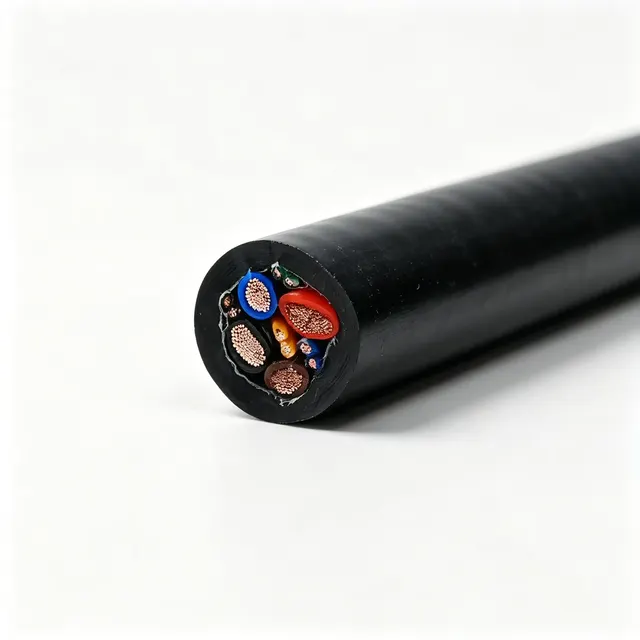 4×2×24AWG (UTP) + 2×14AWG + 2×12AWG
 Custom
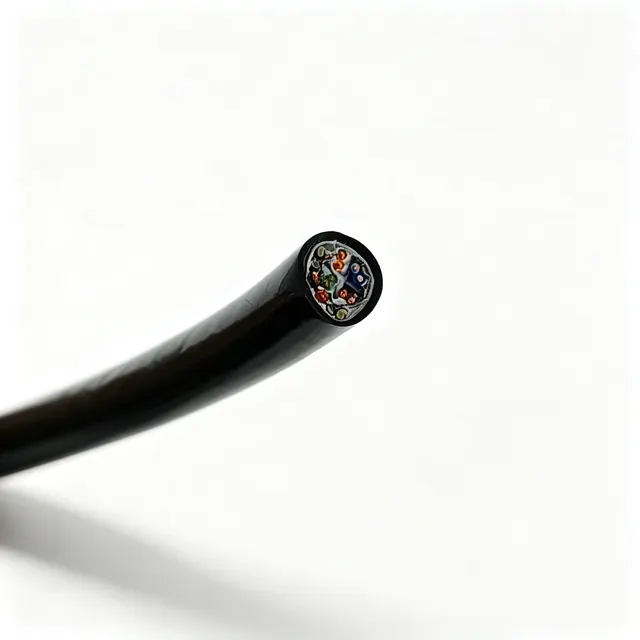 Longitudinally watertight cable 2×22AWG+STPCAT6-100KG
 PDK81301
Engineering enquiry