Watertight Power Cable 8×1.5mm² TPU 12mm
Watertight Optoelectric Cables · Marine & Subsea
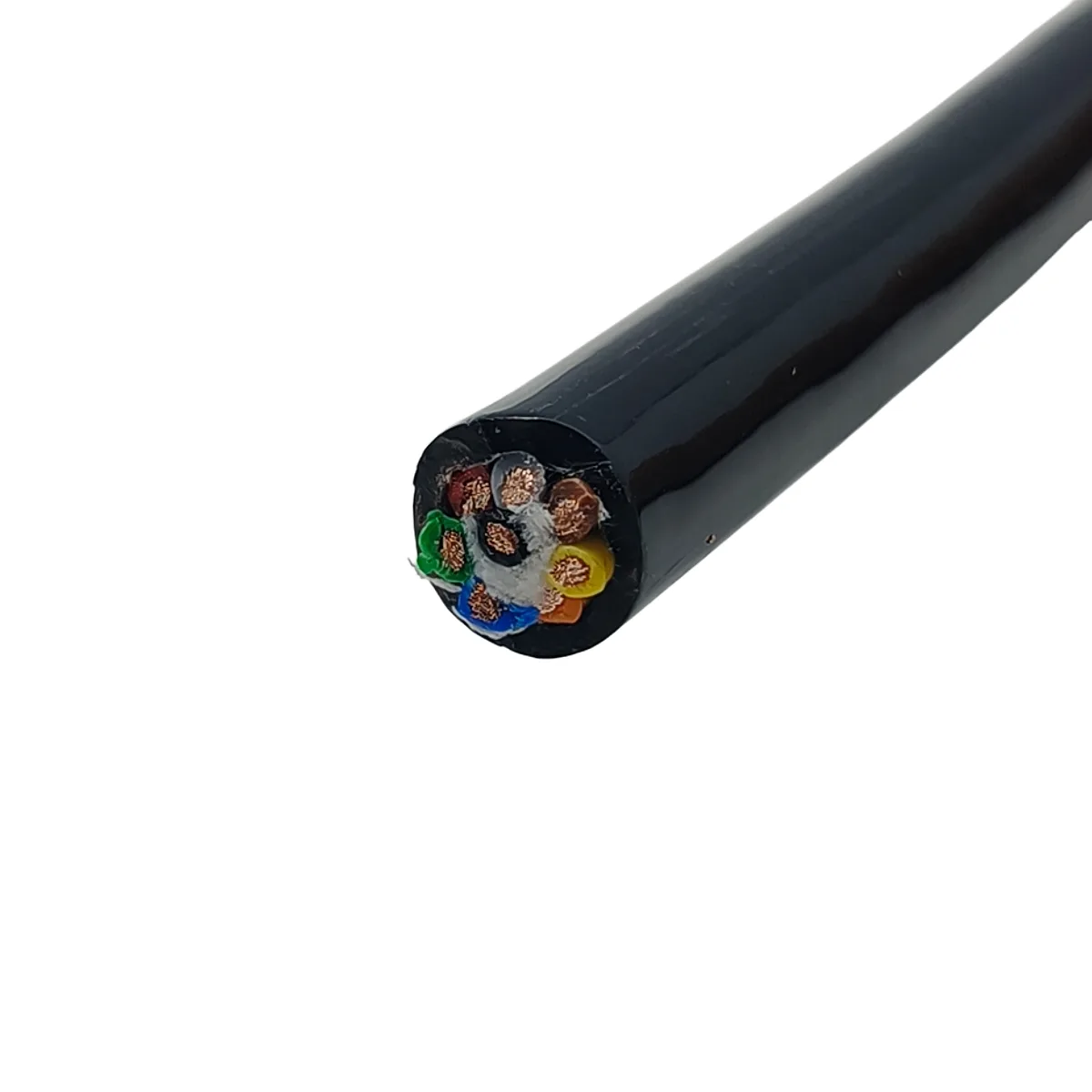
Watertight cable 8×1.5mm²
Watertight eight-core 1.5mm² power cable with bare copper conductors, PP insulation and a 1.5mm TPU jacket, 12±0.3mm OD, for wet and submersible duty.
Product overview
The 8×1.5mm² watertight cable belongs to our watertight cable series. It is a multi-core construction of eight power cores with a black polyurethane jacket, intended mainly for equipment that is in long-term contact with water or briefly immersed. Compared with standard cable for land use, its emphasis is not the current capacity of a single core but the sealing and roundness of the whole cable: after installation, paths for water to penetrate along the axis and radially are blocked as far as possible, so the core assembly keeps stable electrical performance in damp conditions.
This cable type is normally used for the supply circuits of underwater and surface equipment, such as underwater vehicles and their ancillary units, underwater luminaires and cameras, underwater sensors and measuring instruments, and marine deck equipment. The section between above-water and underwater parts of the equipment is often deployed, bent and dragged repeatedly, so flexibility, abrasion resistance and jacket integrity are all required.
Construction and materials
The conductor and insulation are the basis of the electrical performance, while cabling and the outer jacket determine the sealing and mechanical durability of the whole cable. This size is built as follows:
- Conductor: stranded bare copper wire; stranded diameter of each core conductor 1.6mm
- Insulation: PP, 0.55mm thick; insulated core diameter 2.7±0.08mm
- Cores and colours: eight cores in black, red, green, blue, orange, yellow, grey and brown
- Cabling: eight cores cabled in one pass, diameter 8.91mm; interstices filled with cotton yarn, outer wrap of non-woven tape
- Outer jacket: TPU, 1.5mm thick, black; finished outer diameter after extrusion 12±0.3mm
The conductor is stranded from multiple bare copper wires rather than being a single solid wire, so that the same cross-section gives better bending behaviour: in a stranded construction the individual wires can slide against each other when bent repeatedly, stress is distributed and local fatigue failure of the conductor is unlikely. The stranding direction and construction follow the process parameters, and the finished cross-section is round with an even diameter, which keeps insulation thickness stable during extrusion.
The insulation is polypropylene, applied over the conductor to insulate and separate it. PP insulation has stable dielectric properties and low water absorption, so insulation resistance does not readily fall through moisture uptake in damp conditions; its surface is relatively smooth, so cores do not embed in each other during cabling.
The eight insulated cores are colour coded and cabled in one pass, with cotton yarn filling the interstices so the cross-section stays circular under load, cores do not shift and the extruded jacket wall is more even. Non-woven tape is wrapped over the core assembly both as a separation layer protecting the insulated cores from pressure and friction during jacket extrusion and as a binding and cushioning layer.
The outer jacket is thermoplastic polyurethane, extruded over the core assembly to form a continuous sealing layer. A polyurethane jacket balances abrasion, oil, hydrolysis and tear resistance and suits installation where the cable rubs against deck, winch and fairlead; a black jacket does not age visibly in sunlight and damp conditions.
Key characteristics
- Watertightness: core filling and the extruded jacket together reduce the paths for water to penetrate axially and radially
- Roundness: fillers and tape keep the cross-section circular, the jacket wall even and crush resistance higher
- Flexibility: stranded conductors with a cabled construction suit frequent deployment and bending
- Jacket durability: polyurethane resists abrasion, oil and hydrolysis in damp, rubbing conditions
- Clear identification: eight cores in different colours simplify termination and maintenance on site
- Customisable: core count, cross-section, jacket colour and length can all be adjusted to requirements
Electrical and mechanical performance
Insulation resistance is one of the most important factory measurements for a watertight cable. Insulation resistance is tested core by core during production, the measured value must be above the lower limit given in the specification document, and every core is recorded to confirm that an adequate insulation level is maintained when immersed or in high humidity.
The insulated cores are also spark tested and voltage tested before and after extrusion and cabling to check for breakdown points or local defects in the insulation. Withstand voltage, long-term permissible operating temperature and minimum bending radius depend on the insulation and jacket materials selected, the conductor cross-section and the actual service conditions; they are determined per project and agreed in the specification document confirmed by both parties.
Mechanically, both cable ends usually have to mate with equipment glands, watertight connectors or potting kits, so jacket roundness, outer diameter tolerance and core position stability matter. Core filling and taping are what keep the structure stable under tension, bending and water pressure, preventing cores from shifting or the jacket from being crushed out of shape.
Typical applications
- Power supply circuits for underwater vehicles and underwater working equipment
- Connection leads for underwater cameras, luminaires, sensors and measuring instruments
- Deck-to-underwater sections of marine and offshore equipment
- Fixed lines laid long term in damp, humid conditions
- Dragged power applications requiring repeated deployment and bending
In these applications the cable is often routed along winches, fairleads and deck edges and is frequently rubbed and bent; the abrasion and tear resistance of the jacket and the stability of the core assembly directly affect service life and insulation reliability.
Selection and customisation notes
Three items should be confirmed first: supply voltage and current; installation method (fixed or frequently deployed); and service environment (fresh water or seawater, temperature range, presence of oil or chemical media). On that basis, select core count, conductor cross-section, insulation and jacket materials, jacket colour and outer diameter tolerance.
Where the cable has to mate with connectors or potting components, interface dimensions and sealing method can be provided in advance, and outer diameter tolerance, core arrangement and jacket surface condition can be controlled to suit the interface; length and packing are subject to the specification document confirmed by both parties.
Where higher water-blocking grade, tensile strength or bending performance is required, this can be achieved by adjusting the conductor construction, the filling and taping layers, or the jacket material and thickness; the specific solution is confirmed separately against the installation conditions. Watertight cables can be supplied in different specification combinations so that users can select for their actual duty.
Related in Watertight Optoelectric Cables
 4×2×24AWG (UTP) + 2×14AWG + 2×12AWG
 Custom
 Longitudinally watertight cable 2×22AWG+STPCAT6-100KG
 PDK81301
Engineering enquiry