Watertight TPU Cable 4x0.25 mm2 - Shielded, 5.9 mm OD, Grey Sheath
Watertight Optoelectric Cables · Marine & Subsea
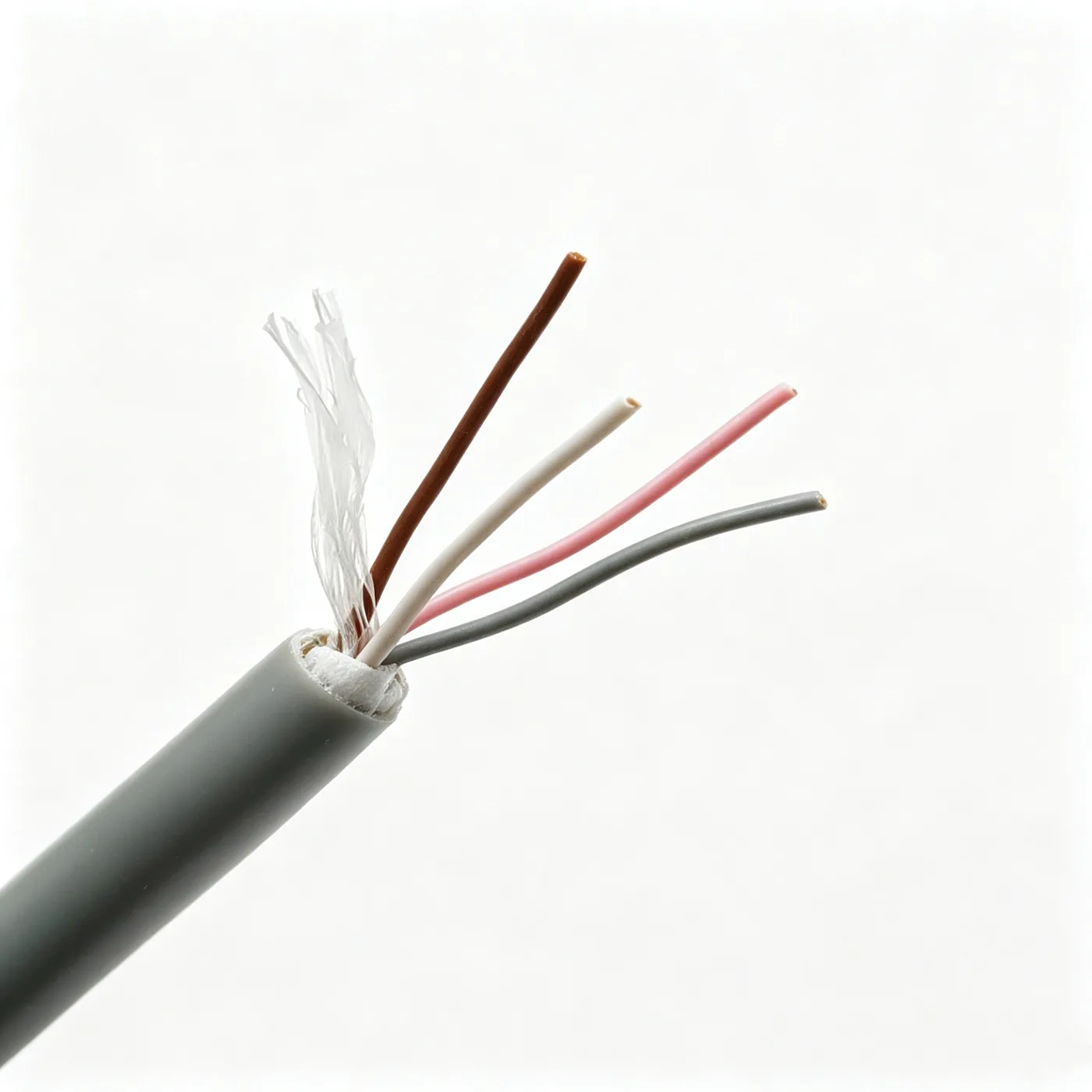
TPU cable 4x0.25
Watertight four-core TPU cable, 4x0.25 mm2 bare copper, PE insulation, tinned copper braid shield and 1.1 mm TPU sheath, 5.9 mm outer diameter.
Product overview
Watertight cables are used on equipment and harnesses that work permanently underwater or in damp environments, and reliability depends first on whether the insulation is dense and whether filling and wrapping after cabling are tight, and only then on how closely the outer sheath fits the internal construction. TPU cable 4x0.25 is a four-core small cross-section construction: the overall diameter is modest and the bending radius is small, which suits control signals, sensor supply and small actuators, where the cross-section requirement is low but flexibility and outer diameter are critical. The product is manufactured to watertight cable design and inspection requirements; core colors, sheath appearance and outer diameter tolerance are fixed once the specification is confirmed, which allows several batches to be interchanged within one project.
Construction and materials
- Conductor: multi-strand bare copper with a nominal cross-section of 0.25 mm2 and a stranded conductor diameter of 0.65 mm. The multi-strand construction distributes stress more evenly under repeated bending and eases routing in confined spaces.
- Insulation: PE, 0.25 mm thick; the insulation diameter of the four cores is held at 1.25 ±0.05 mm, colored white, brown, pink and grey, with the final color code as agreed in the specification. Polyethylene insulation has stable dielectric properties and low water absorption, so insulation resistance does not readily fall after long immersion.
- Cabling: the four cores are cabled in a left-hand lay in the confirmed sequence, with a cabled diameter of 2.9 mm and a transparent PP rope filler in the center. The filler keeps the core cross-section round so that it does not collapse under pressure or during gland assembly, and the relative positions of the cores are not disturbed.
- Wrapping: after cabling, non-woven tape is applied first, then polyester tape. The non-woven tape cushions and separates, the polyester tape provides a binding force that holds the shape, and the two layers reduce compression of the core in the subsequent braiding and extrusion processes.
- Shield: 16-carrier tinned copper braid with approximately 85% coverage. The braid serves both as an electromagnetic shield and as mechanical protection; the tinned layer resists oxidation better in damp environments, so contact resistance does not rise through oxidation over time.
- Bedding: non-woven tape is applied again after braiding, with a braided diameter of 3.4 mm, giving an even support surface for the outer sheath extrusion and avoiding local thin spots in the sheath.
- Outer sheath: TPU, 1.1 mm thick, grey, finished outer diameter 5.9 ±0.1 mm. The thermoplastic polyurethane sheath is abrasion-resistant, hydrolysis-resistant and flexible at low temperature, and bonds closely to the inner wrapping, reducing paths for water to penetrate along the sheath-to-core interface.
Key features
- Dense construction: insulation, center filler, double wrapping, braid and sheath are built up layer by layer with small voids between them, which limits longitudinal water accumulation.
- Flexible and easy to route: small cross-section multi-strand conductors with a loose cabling lay have little spring-back in bending, which suits routing paths inside equipment and between subsea mechanisms that flex repeatedly.
- Interference rejection: the tinned copper braid fully covers the core and shields the control signals, reducing coupling from nearby power lines.
- Sheath durability: the TPU outer sheath stays intact in damp, oily and frequently rubbed conditions and does not readily crack, become tacky or wear through.
- Compact diameter: the four-core construction has a small overall diameter and passes through feed-through holes, sealing glands and watertight connectors, reducing termination effort on site.
- Clear identification: the four cores are distinguished by color, so terminations can be matched by color after stripping, lowering the chance of wiring errors.
Electrical and mechanical performance
- Rated voltage, long-term operating temperature range, minimum bending radius and long-term permitted pull: subject to the specification document confirmed by both parties.
- Water pressure and longitudinal water-blocking requirements: agreed in the specification according to the actual working depth, immersion time and inspection method.
- Conductor DC resistance, insulation resistance and withstand voltage test: inspected to the selected cross-section and the project standard.
- Shielding effectiveness: varies with braid density and the number of braid layers and can be adjusted to the strength of the interference source; specific values are given when the specification is confirmed.
- Sheath mechanical properties: tensile strength, elongation at break and tear strength accepted to the confirmed material specification.
- Finished length and weight: supplied to fixed-length requirements, with tolerances agreed in the contract.
Typical applications
- Control, signal and sensor circuits on underwater vehicles and submersibles.
- Power and control harnesses for tank test rigs, subsea lights and camera units.
- Short connections through hull penetrations and sealing glands on marine and offshore equipment.
- Industrial wiring in damp workshops, wash-down stations and seafood processing equipment that is in constant contact with water.
- Shielded low-level signal lines, such as encoders, position sensors and miniature actuators.
Selection and customization notes
- Core count and cross-section: the core count can be adjusted to the number of circuits; signal and power circuits can be run in separate cables or combined in one sheath.
- Shield type: braid, foil or composite shield, selected according to interference level and available installation space.
- Sheath color and marking: color can be confirmed per project; marking content and metre marking are as agreed.
- Termination: compatible with watertight connectors and potted joints; termination process parameters are recommended to be supplied by the manufacturer after confirmation.
- Delivery form: full reels or fixed lengths, with reel length and packaging specified in the contract.
- For clearer technical data, please provide working depth, ambient temperature, bending frequency and interface type, and PAIDE Cable can issue the corresponding specification and drawings.
Related in Watertight Optoelectric Cables
 4×2×24AWG (UTP) + 2×14AWG + 2×12AWG
 Custom
 Longitudinally watertight cable 2×22AWG+STPCAT6-100KG
 PDK81301
Engineering enquiry