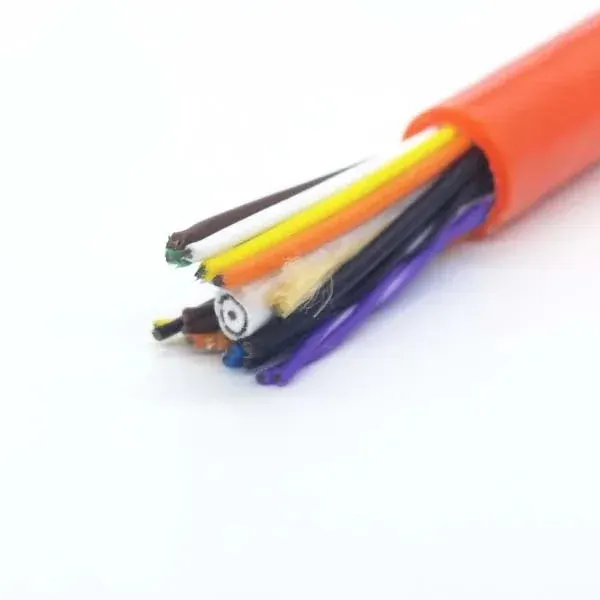
PDK71300 Pipeline Robot Cable 2×20AWG + STP CAT6, 10.3 mm
Pipeline Inspection Robot Cables · Industrial Automation
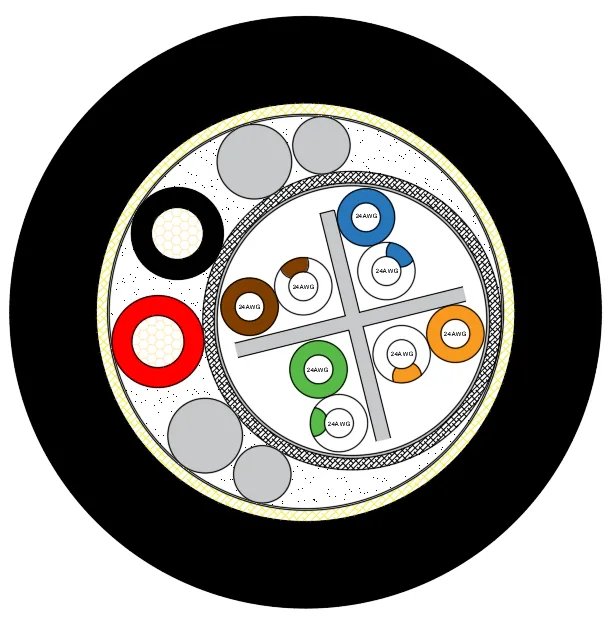
PDK71300
Pipeline inspection robot cable with 2 × 20AWG power cores and an STP CAT6 data pair, PE insulation, PUR sheath, 10.3 mm diameter, -40 °C to +90 °C.
Product introduction
Conditions inside enclosed spaces such as municipal drainage networks, chemical park effluent pipes and oil and gas transmission lines are complex and cannot readily be inspected by people, so pipeline inspection robots and downhole camera systems have become important tools for pipe cleaning, maintenance and acceptance testing. The cable linking the surface control equipment to the robot in the pipe must continuously supply power to the travel mechanism, lamps and cameras, and must carry video, control commands and sensor data back and forth reliably in real time; it is one of the critical parts determining whether the whole inspection system works stably.
PAIDE Cables has developed the PDK71300, PDK71301 and PDK81301 series of pipeline robot cables for this application, also known as pipeline inspection cables or pipeline camera cables. Their common feature is a multi-unit composite construction that integrates power cores, video coaxial units, twisted signal pairs and even fibre units into one cable, so that a single cable provides supply, video return, control and communication. This simplifies manhole handling and reel arrangement and makes it easy to deploy and recover with an inspection vehicle.
From a design standpoint, a pipeline robot cable has to satisfy four requirements at once. First, flexibility: the cable is dragged back and forth as the robot advances, reverses and turns, so the cores must be fine and supple to avoid broken conductors after prolonged bending. Second, abrasion resistance: the cable is dragged directly over the ground and the pipe wall, so the sheath must withstand continuous friction. Third, tensile performance: deployment, dragging and water flow all apply tension, so a suitable tensile structure is needed. Fourth, environmental tolerance: drainage pipes are damp, oily and often in contact with acids, alkalis and salt spray, so the cable needs corresponding water, oil and corrosion resistance. The sections below cover construction and materials, electrical performance and model configurations in turn; specific values are given in the relevant sections and the rest is described qualitatively, so that information can be found quickly.
Construction and materials
For the conductor, pipeline robot cables generally use finely stranded bare copper or tinned copper to achieve good flexibility. In the PDK71300-2×20AWG+STP CAT6, the power cores are multi-strand and the STP CAT6 data pairs use a 7/0.2 construction; in the PDK71300-2×19AWG+2x2×26AWG-250KG, the power and signal cores use 34/0.15 and 19/0.1 constructions respectively. The video coaxial unit can also use silver-plated copper conductors where required, to improve high-frequency performance. Fine-strand stranding makes the cores flexible with a uniform stranded diameter and avoids individual wire breakage under repeated bending, which is the main difference between pipeline robot cables and ordinary fixed-installation cables in conductor processing.
Insulation material is chosen according to signal type and temperature requirement. Power and signal cores mostly use PE insulation, colour-coded red, black, green and yellow for easy identification on site; FEP insulation can be used where temperature and electrical performance requirements are higher. The inner conductor of the video coaxial unit is usually covered with foamed PE insulation and then an extruded FEP layer to stabilise characteristic impedance and protect the inner conductor. In the PDK71301-6×0.48+4×2×0.14+75-1.5-500kg, for example, the average FEP insulation thickness of the cores is about 0.15 mm, the average foamed insulation thickness of the coaxial unit is about 0.5 mm, and the finished coaxial unit diameter is about 2.6 mm, which suits routing in the narrow space of a well.
For shielding and interference, the video and network data units need effective shielding. The STP CAT6 data pairs use aluminium foil plus tinned copper braid with a twisted construction to suppress crosstalk between pairs; the coaxial unit's own outer conductor also acts as a shield. Where motors, power cores and signal cores share one cable, an overall shield can be added as required to improve protection against interference from downhole motors and heavy-current lines. The shield also provides earthing and drain paths, which helps keep signals stable while the cable is dragged over long periods.
The tensile structure is another design focus. PAIDE configures aramid braid or filler reinforcement according to the target tensile class, with several classes defined by working depth and equipment weight; the corresponding values are given in the model data. Some models use a 16-strand 1000D LCP braid as the reinforcement layer, combining high strength with flexibility. In the PDK81301-2×0.75+2SMF-1000KG, for example, aramid braid reinforcement is applied over the inner sheath before the outer sheath is extruded, and two single-mode fibres (G657A2) are protected inside the cable in a spiral armour arrangement, addressing both fibre bend tolerance and overall tensile strength.
The sheath directly determines abrasion and environmental performance. Pipeline robot cables mostly use polyurethane sheaths such as TPU or polyether polyurethane, usually black but also orange and other colours that are easier to see in dark surroundings; polyurethane performs well in abrasion, oil, hydrolysis and acid and alkali resistance, and with a suitable wall thickness (typically 1.0 to 1.8 mm average) gives the inner cores reliable mechanical protection. Some models, such as the PDK71301-6×0.48+4×2×0.14+75-1.5-500kg, use a matt TPU sheath with an inner PTFE tape to locate the cores, for more demanding in-well conditions.
Electrical performance and main models
Several representative models in the series and their finished diameters are listed below, numbered 1 to 5 from top to bottom, where D denotes the finished cable diameter:
- Model 1, PDK71300-2×20AWG+STP CAT6: finished diameter 10.3 ± 0.3 mm.
- Model 2, PDK81301-2×0.75+2SMF-1000KG: finished diameter 9.5 ± 0.3 mm.
- Model 3, PDK71300-12mm tube+26×0.5mm²+ATS 1×2×24AWG-1000KG: finished diameter 19.1 ± 0.2 mm.
- Model 4, PDK71301-6×0.48+4×2×0.14+75-1.5-500kg: finished diameter 9.3 ± 0.5 mm.
- Model 5, PDK71300-2×19AWG+2x2×26AWG-250KG: finished diameter 6.4 ± 0.2 mm.
On rated voltage, model 4 among the five uses 300/300 V and the other four use 300/500 V; these two values are the common ratings for pipeline robot cables, and products at higher ratings such as 450/750 V, 0.6/1 kV and 0.75/1 kV are also available in the series depending on core section and application.
Maximum conductor DC resistance at 20 °C varies with cross-section: for example about 25 ohm per km for 0.75 mm² and about 34.5 to 37.4 ohm per km for 0.5 mm². In model 5 the power and signal cores are about 28.3 and 146 ohm per km respectively, and the 24AWG construction is about 89.2 ohm per km, all of which can be used directly when calculating supply and signal losses. The STP CAT6 data pairs are designed for a characteristic impedance of 100 ± 10 ohm, supporting stable data communication for pipeline inspection systems.
Operating temperature is graded by model: model 1 is -40 °C to +90 °C, model 2 is -30 °C to +105 °C, models 3 and 5 are both -35 °C to +105 °C, and model 4 is -20 °C to +125 °C. On minimum bending radius, model 1 is 10D, model 2 is 20D and the other three are 15D. On tensile design, models 2 and 3 are in the 1000KG class, model 4 in the 500KG class and model 5 in the 250KG class, while model 1 is marked above 2000 N.
Typical applications
Pipeline robot cables are mainly used with pipe crawler robots, inspection vehicles and downhole camera systems. Typical uses include internal inspection of municipal drainage and stormwater pipes and condition assessment before desilting acceptance; routine inspection of effluent pipes in chemical parks and factories; in-line inspection of oil and gas transmission lines; and video survey of confined spaces such as culverts, tunnels and shafts. The cable is normally mounted on a reel on the inspection vehicle and paid out in step with the robot, with length and tensile class selected according to working depth and equipment weight. Because the work site is often cramped and poorly lit, cable colour and print marking should also aid identification, to shorten handling and fault-finding.
Customisation and ordering notes
Pipeline robot cables are typically multi-unit assemblies with flexible core combinations. Users can work with the PAIDE technical team to define core count, cross-section, tensile class and sheath colour according to the robot's power circuits and load, video format, communication interface and working depth. For higher temperatures, more complex signals or fibre communication, FEP insulation, LCP braid or fibre composite options can be selected. Specific diameters, resistances, temperatures and other parameters not listed here are subject to the final confirmed specification, and samples and technical data can be requested from PAIDE as needed.
Related in Pipeline Inspection Robot Cables
 PDK71300
 PDK71301
Engineering enquiry